
If a cataract is making daily life hard and your eye doctor shows it on exam, you may qualify for surgery.
In the U.S., there is no single eye-chart score, age cutoff, or “right time” that applies to everyone. I’d sum it up like this:
- You may qualify if your cataract affects driving, reading, work, cooking, or safe movement at home.
- Glasses or contacts may no longer help enough, even if your chart vision does not look that bad.
- Your doctor must show that the cataract is the main reason for your vision trouble.
- Insurance often wants records like best-corrected vision, exam findings, imaging, and notes about daily limits.
- Surgery may wait if your cataract is mild or if another eye or health problem needs care first.
A few points matter most. Cataracts cause more than 50% of blindness worldwide, but surgery is often done based on function, not just numbers on a chart. In the U.S., many insurers look for proof that vision loss affects day-to-day tasks, not only a test result like 20/40 or 20/50. That means two people with the same chart score may not be treated the same way.
Bottom line: I would not ask, “Is my cataract bad enough on paper?” I’d ask, “Is it stopping me from living safely and doing what I need to do?” That is often what moves surgery from optional to medically needed.
When to get Cataract Surgery? | Eye Surgeon Explains
sbb-itb-5ef6ec9
When Cataracts Are Bad Enough to Warrant Surgery
A cataract becomes a surgical issue when the clouding in your eye’s natural lens is no longer corrected well enough with glasses or contact lenses. There isn’t one eye-chart score that automatically means you need surgery. Doctors look at the full picture: how your vision has changed, what tasks have become harder, and how much all of that affects your day-to-day life.
Vision Changes Doctors Look For
Doctors often look for symptoms like blurred or cloudy vision, glare, halos around lights, poor night vision, reduced contrast sensitivity, and faded colors. Best-corrected vision is often used as one factor. But that number doesn’t decide everything. A person can have a chart result that looks “okay” and still struggle in daily life.
How Daily Activity Limitations Factor Into Eligibility
Daily function matters a lot. If cataracts make it harder to read, drive, recognize faces, watch TV, cook safely, or handle daily tasks on your own, that can support the case for surgery.
Here’s how symptoms often connect to daily limits and why that matters:
| Visual Symptom | Related Daily Limitation | What It Means |
|---|---|---|
| Glare and halos | Difficulty driving at night or in bright sunlight | Safety and lifestyle impact support candidacy |
| Poor night vision | Difficulty moving safely after dark | Directly affects personal safety |
| Reduced contrast sensitivity | Trouble cooking or navigating the home | May support candidacy depending on severity and patient goals |
| Faded colors | Difficulty with hobbies, work, or detailed tasks | Supports candidacy if it affects professional or personal function |
It helps to come to your exam with clear examples. Maybe you stopped driving at night. Maybe reading labels in the kitchen has become a hassle. Maybe work takes longer because detail is harder to see. Those kinds of details give doctors a better sense of how much the cataract is affecting your life.
Other eye conditions can also affect whether surgery should move forward.
Medical and Eye Health Factors That Affect Candidacy
Other eye issues can affect whether surgery should happen now or wait until later. That matters because cataract surgery helps most when removing the cataract is likely to improve vision.
Eye Conditions That Can Make Surgery Sooner
Sometimes, a cataract gets in the way of treating or even monitoring another eye problem. For people with diabetic retinopathy or age-related macular degeneration (AMD), that can mean cataract removal needs to happen first.
For people with glaucoma, cataract surgery may be done along with a procedure that helps lower eye pressure. Dry eye and meibomian gland blockage should also be treated before surgery so eye measurements stay accurate. And if someone has corneal disease or disease affecting the outer part of the eye, surgery can become more complex.
In some cases, cataract surgery comes first so doctors can treat another eye condition afterward.
Health Factors Reviewed Before Surgery
Doctors also look at overall health before moving ahead. Conditions like diabetes and high blood pressure can affect eye health and healing. They also review recovery needs and follow-up care, including whether you can stick with post-op instructions after surgery.
Age and Insurance Requirements in the U.S.
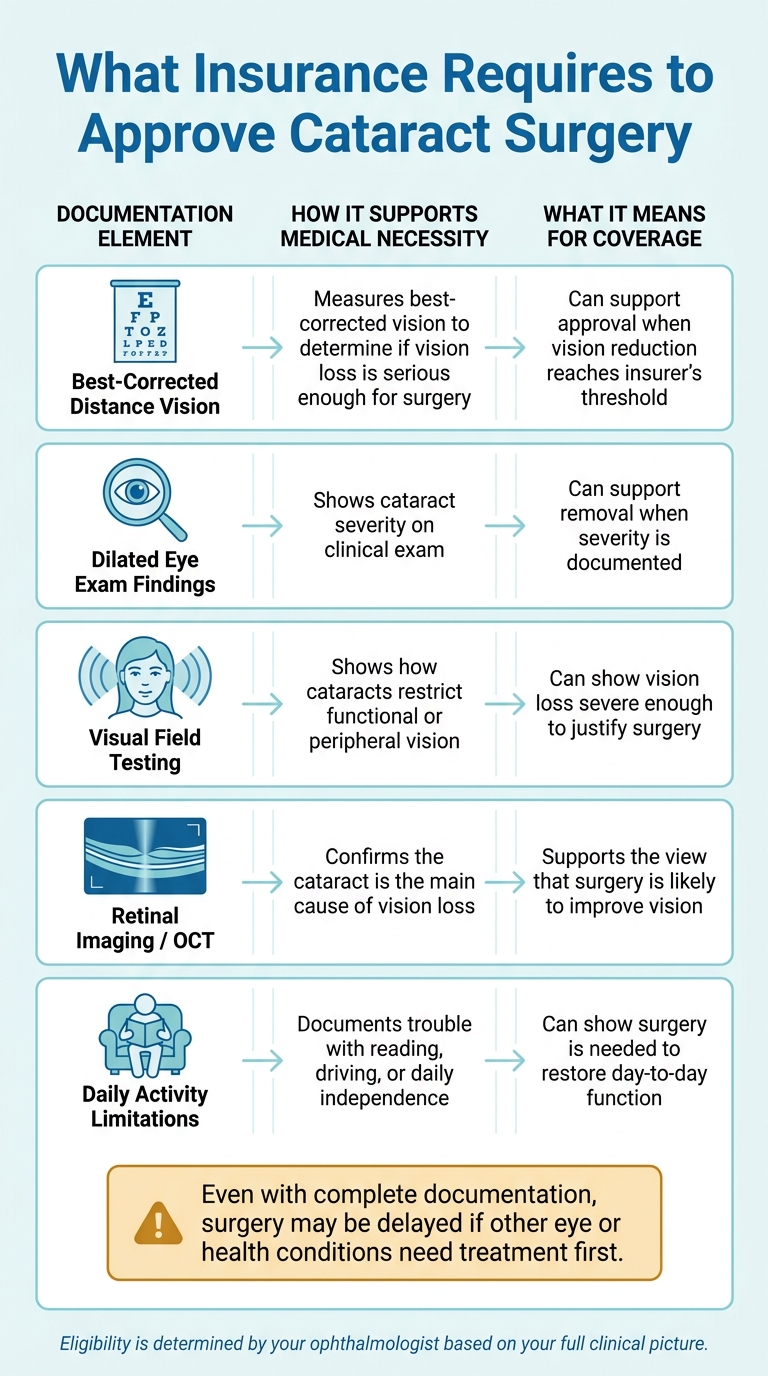
Cataract Surgery Eligibility: Key Factors at a Glance
Why Age Alone Does Not Determine Eligibility
Cataracts tend to show up more often with age. But age by itself doesn’t decide who can get cataract surgery.
There is no fixed minimum or maximum age for the procedure. Instead, doctors look at one main thing: how much the cataract is getting in the way of daily life. That often means trouble with reading, driving, or staying independent. Those same notes also help when it’s time to show an insurer why surgery is needed.
What Insurers Typically Need Documented
In most cases, insurance wants proof that the cataract is medically necessary to treat and that it is causing functional vision loss. Insurers also tend to rely on the ophthalmologist’s findings when deciding whether to cover surgery.
| Documentation Element | How It Supports Medical Necessity | What It Means for Coverage |
|---|---|---|
| Best-corrected distance vision | Measures best-corrected vision to help determine whether vision loss is serious enough for surgery | Can support approval when vision reduction reaches the insurer’s threshold |
| Dilated Eye Exam Findings | Shows cataract severity | Can support removal |
| Visual Field Testing | Shows how cataracts restrict functional or peripheral vision | Can show vision loss severe enough for surgery |
| Retinal Imaging / OCT | Evaluates the retina to confirm the cataract is the main cause of vision loss | Can support the view that surgery is likely to improve vision |
| Daily Activity Limitations | Documents trouble with reading, driving, or daily independence | Can show that surgery is needed to restore day-to-day function |
Even with the right records, some people may still have to wait if other eye conditions or health issues need attention first.
Who May Not Qualify Yet and Key Takeaways
When Surgery May Be Delayed or Not Recommended
Some people may qualify on paper but still not be ready for surgery. Even if a cataract meets the basic rules, doctors may wait if the timing isn’t right.
Mild cataracts that aren’t causing meaningful day-to-day problems are usually watched over time until symptoms get worse.
Doctors also look at whether another eye condition or health issue is the main reason vision has gotten worse. If another eye disease is the primary cause of vision loss, that problem is treated first. Glaucoma, diabetic retinopathy, and AMD can all limit how much vision may improve after cataract surgery.
Other health problems can slow things down too. Uncontrolled diabetes, high blood pressure, or other medical issues may delay surgery until they are stable. Before moving ahead, doctors review the eye exam and medical history to make sure the cataract is the main cause of vision loss and that the patient is cleared for surgery.
And here’s the plain truth: timing matters. If the situation changes, eligibility can change too.
FAQs
Can I still qualify if my vision seems okay on the eye chart?
Yes. You may still qualify for cataract surgery even if your vision looks acceptable on a standard eye chart.
Visual acuity is only one part of the decision. Your ophthalmologist will also look at your overall eye health, the cloudiness of your lens, and how your symptoms affect day-to-day life. That means things like trouble driving at night, glare, or blurry vision can matter just as much as the letters on the chart.
A full eye exam is needed to figure out whether surgery makes sense for you.
What should I tell my doctor to show a cataract affects daily life?
Tell your doctor how cataracts affect your day-to-day life and your independence. Be clear about what feels harder now, how much your vision has changed, and what that change means for your quality of life.
Give specific examples. For instance, mention if you’re having trouble reading, driving, or handling routine tasks around the house. It also helps to say when you first noticed these problems and whether they’ve gotten worse over time.
Can other eye or health problems delay cataract surgery?
Yes. Other eye or health issues can affect when cataract surgery should happen and how it should be handled.
Doctors often look at cataracts alongside conditions such as glaucoma, diabetic retinopathy, and age-related macular degeneration. That matters because cataracts don’t always exist on their own. Sometimes there’s more than one thing affecting your vision, and each issue can shape the treatment plan.
In some cases, those conditions may be treated before cataract surgery or at the same time as surgery. The goal is simple: support the best possible visual outcome.
The Eye Center of Northern Colorado provides full evaluations to help decide when surgery is appropriate.