Melatonin may help support the aging eye, but it is not a proven treatment for AMD, cataracts, or glaucoma. The main takeaway is simple: melatonin levels often drop with age, lens changes can reduce the light signals that help set the body clock, and both shifts may add stress to the retina and other eye tissues.
If you want the short version, here it is:
- Melatonin is made in the brain and in the eye
- It helps with retinal timing, photoreceptor support, and daily eye-pressure patterns
- Aging often brings lower melatonin levels and weaker circadian rhythms
- By age 65, about 90% of people have measurable lens changes
- AMD affects more than 10% of U.S. adults over age 75
- The clearest research links so far are with AMD and cataracts
- Melatonin supplements still need more clinical study for eye health
- New blur, glare, or poor night vision should lead to an eye exam
Put another way: if you are getting older and notice more glare, weaker night vision, or changes in sleep, the issue may involve both your body clock and your eyes. Routine eye exams and a medication review matter more than guessing with over-the-counter supplements.
This article explains what melatonin does in the eye, how aging changes that system, where the research is strongest, and what older adults in the United States should keep in mind.
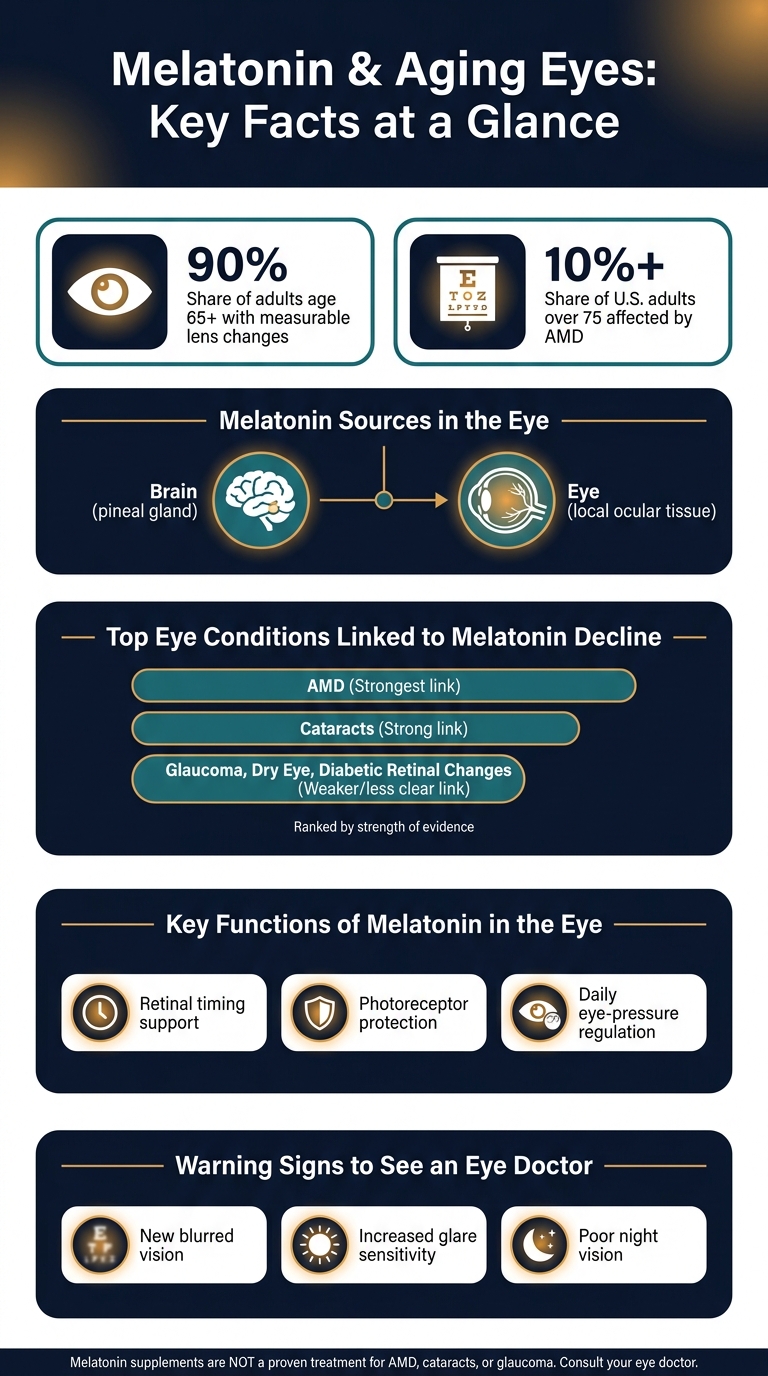
Melatonin & Aging Eyes: Key Facts at a Glance
Age-Related Macular Degeneration (AMD) and Melatonin
sbb-itb-5ef6ec9
How Melatonin and Circadian Rhythms Change With Age
As the eye gets older, changes in the lens can cut down the amount of light that reaches the retina and weaken circadian signaling. That matters because light hitting the retina helps set the timing of melatonin at night.
Older Adults: Lens Changes and Rhythm Disruption
In older adults, age-related lens changes can make the light signal that sets daily rhythms less steady. Younger eyes let more light reach the retina, which helps keep daily rhythm cues stronger. By age 65, about 90% of people have measurable lens changes. Over time, the lens can grow cloudy and lead to cataracts, which can cause blurred or distorted vision.
How Lens Aging and Cataracts Disrupt Circadian Signaling
As cataracts get worse, night vision may decline and glare can become more noticeable. Cataract surgery removes the cloudy lens and replaces it with an IOL. By restoring more retinal light input, cataract surgery may strengthen circadian cues. That change in light input sets up the eye-disease findings discussed next.
What Studies Show About Melatonin and Age-Related Eye Disease
Retinal Protection, Oxidative Stress, and Inflammation
As light signaling drops with age, the next step is to look at where melatonin fits into common eye problems. The research is still limited. That said, the clearest links so far show up with AMD and cataracts.
Melatonin has antioxidant effects, and that may help shield retinal tissue from oxidative stress and inflammation. Those two processes are tied to the progression of age-related eye disease. Put simply, the idea is that melatonin may act like part of the eye’s defense system when wear and tear builds up over time.
AMD, Glaucoma, Dry Eye, Cataract, and Diabetic Retinal Changes
Among the eye conditions studied with melatonin, AMD and cataracts come up most often. In AMD, lower melatonin levels in older adults may mean less protection for the retina against oxidative damage. In cataracts, the lens changes that cut down melatonin-related light input may also reflect the broader oxidative changes that come with aging.
Glaucoma, dry eye, and diabetic retinal changes have also been studied, but the link is not as clear. Right now, AMD and cataracts are where the evidence shows up most often.
Age Group Comparison: Melatonin and Ocular Findings
This pattern shows up most strongly in older adults, which is where most of the findings cluster. Across age groups, the clearest takeaway is simple: age-related eye disease findings tend to gather in older adults, where melatonin decline and cataract-related light loss may have more effect on circadian eye signaling than they do in younger adults.
That matters when older adults and clinicians think through sleep, eye disease risk, and routine eye care.
Clinical Relevance for Older Adults in the United States
What Current Research Says About Melatonin Use
Researchers are looking at whether melatonin might help slow age-related eye disease. But the picture is still incomplete. Randomized clinical trials are needed to confirm whether it helps, and to sort out the right timing and dose.
For older adults, that gray area matters. When the science is still being worked out, safety and routine eye care matter even more.
Safety, Supplement Labeling, and Medication Considerations
For older adults, the main issue is how melatonin supplements are used in day-to-day care. In the United States, over-the-counter melatonin can vary from one brand to another. So the amount listed on the label may not always match what a person expects.
The biggest concerns are pretty practical:
- Next-day drowsiness
- Medication interactions
That’s why a direct conversation with a physician or eye specialist makes sense. Go over current medications, then talk through whether the timing and dose fit the person’s situation.
How Routine Eye Care Supports Healthy Aging
Poor night vision and glare can point to cataracts, not just circadian disruption. That overlap can muddy the waters. A person may think they’re dealing with a sleep-wake issue when the eye itself is part of the problem.
Routine eye exams help sort that out. They can help tell cataract symptoms apart from circadian changes and spot early changes in the retina, lens, and optic nerve. The Eye Center of Northern Colorado offers comprehensive eye care, along with access to active clinical research such as the CharacterBio dry AMD study, which collects three years of medical record data from patients age 50 and older to better understand disease progression.
Conclusion: What We Know and What Still Needs Study
Researchers are still looking into whether the drop in melatonin that comes with age plays a part in retinal aging and eye disease. At the same time, cataracts can make night vision worse and increase glare as the lens gets cloudy with age. That’s why routine eye care matters even more for older adults.
Just as important, some key details are still unknown. Researchers do not yet know the best dose, the best timing, or which older adults are most likely to benefit from melatonin.
Here’s what stands out from the current evidence:
- Melatonin decline may be one piece of broader age-related eye change, but its clinical role is still not clear.
- Cataracts can affect night vision, along with blurred vision and glare sensitivity.
- Older adults should treat new blur, glare, or night-vision changes as a reason to schedule a routine eye exam.
The evidence is still limited. The biggest open questions are whether melatonin helps over the long term and which older adults are most likely to benefit. For now, the practical next step is routine eye care and a review of sleep supplements with an eye doctor.
FAQs
Can melatonin prevent AMD or cataracts?
There’s no evidence in the search results provided that melatonin can prevent age-related macular degeneration (AMD) or cataracts.
If you’re worried about changes in your vision or your risk for either condition, contact Eye Center of Northern Colorado at (970) 221-2222 to schedule an evaluation.
Why do cataracts affect sleep and circadian rhythms?
Cataracts can also throw off sleep and your body clock in indirect ways. They often make night vision worse and glare harder to handle, so seeing clearly in low light gets tougher. That can disrupt simple evening habits, like moving around the house, reading, or watching TV as you wind down.
Blurred or distorted vision can add to that problem. When nighttime viewing feels uneven or less comfortable, it may chip away at a steady sleep-wake routine.
When should I get an eye exam for glare or night vision changes?
If you’ve started having more trouble seeing at night or bright lights seem harsher than they used to, don’t brush it off. Changes like these can point to issues such as cataracts, and that’s a good reason to schedule a comprehensive eye exam soon.
Finding problems early can help protect your eye health. If your vision doesn’t feel like it used to, contact Eye Center of Northern Colorado to make an appointment.