
Recovering from cataract surgery is a gradual process. Here’s what you need to know:
- Initial Recovery (Days 1–7): Most patients notice improved vision within 24–48 hours, though it may fluctuate. By the end of the first week, distance vision often sharpens, and many can resume light activities.
- Weeks 2–4: Vision becomes clearer, with reduced glare and halos. Patients often return to normal activities like driving or desk work.
- Weeks 5–8: Vision typically stabilizes, and final glasses prescriptions, if needed, are provided. Colors may appear sharper, and lingering symptoms like mild dryness or halos may persist but improve over time.
Key tips for recovery:
- Use prescribed eye drops as directed.
- Avoid heavy lifting, bending, swimming, or exposing your eyes to irritants during the first month.
- Attend follow-up appointments to monitor healing.
While most patients achieve excellent results, contact your doctor immediately if you experience sudden vision loss, severe pain, or unusual symptoms.
Cataract Surgery Recovery: 5 Surprises You Need To Know!
sbb-itb-5ef6ec9
Day-by-Day Changes in the First Week
The first week after cataract surgery often brings the most noticeable improvements in vision. Here’s a breakdown of what you can expect each day to help you feel more at ease during recovery.
What to Expect on Surgery Day
Right after surgery, your vision may seem blurry or foggy. This is due to corneal swelling and dilation drops used during the procedure. Your pupils might stay dilated for up to 24 hours, making you more sensitive to light. Many patients notice that colors appear brighter and more vibrant almost immediately, as the cloudy natural lens is replaced with a clear intraocular lens (IOL).
Before you leave the surgical center, you’ll be given a protective eye shield to wear while sleeping. When outdoors, wraparound sunglasses with 100% UV protection are recommended.
"The eye needs time to calm down from the inflammation that naturally happens during the procedure." – Dr. Rupa Wong, Board-Certified Ophthalmologist
The next 48 hours bring significant changes as your eye begins to adjust.
Days 1–2 After Surgery
Many patients are amazed by how quickly their vision starts to improve. Within the first 24 to 48 hours, you might notice a big jump in clarity. However, it’s normal for your vision to fluctuate – clear one moment and slightly blurry the next. This often happens due to temporary dryness or instability in your tear film.
It’s also common to feel a scratchy or gritty sensation during these early days. Some patients report seeing a faint shimmer as their eye adjusts to the new lens. Using preservative-free artificial tears can help ease dryness and discomfort.
Your main priority during this time is to attend your first post-operative follow-up appointment, typically scheduled within 24 hours of surgery. At this visit, your doctor will check your intraocular pressure and confirm that your eye is healing properly. Most patients are cleared to drive after this appointment if their vision meets safety standards, but it’s a good idea to arrange for someone else to drive you that day.
Days 3–7: Early Milestones
By mid-week, as inflammation and swelling go down, your vision will sharpen, especially for distance. By the end of the first week, most patients can comfortably return to light activities like reading, watching TV, or taking short walks.
| Day Range | What You’ll Likely Notice | Key Actions |
|---|---|---|
| Surgery Day | Blurry vision with brighter, more vivid colors | Rest, wear your eye shield, and avoid driving |
| Days 1–2 | Rapid improvement in clarity with occasional fluctuations | Attend your follow-up, start your prescribed drops, and wear sunglasses |
| Days 3–7 | Sharper distance vision and more stable focus | Resume light activities and stick to your drop schedule |
To protect your eye, avoid heavy lifting, bending, and exposing your eye to water or irritants until your doctor gives the all-clear.
"The first week tends to bring the most dramatic improvement, while the remaining weeks involve subtler refinements in contrast and focus." – Eye Surgery Today
If your vision suddenly worsens or you experience severe pain, flashes of light, or a shadow across your vision, contact your doctor immediately.
Week-by-Week Vision Changes Through the First Month
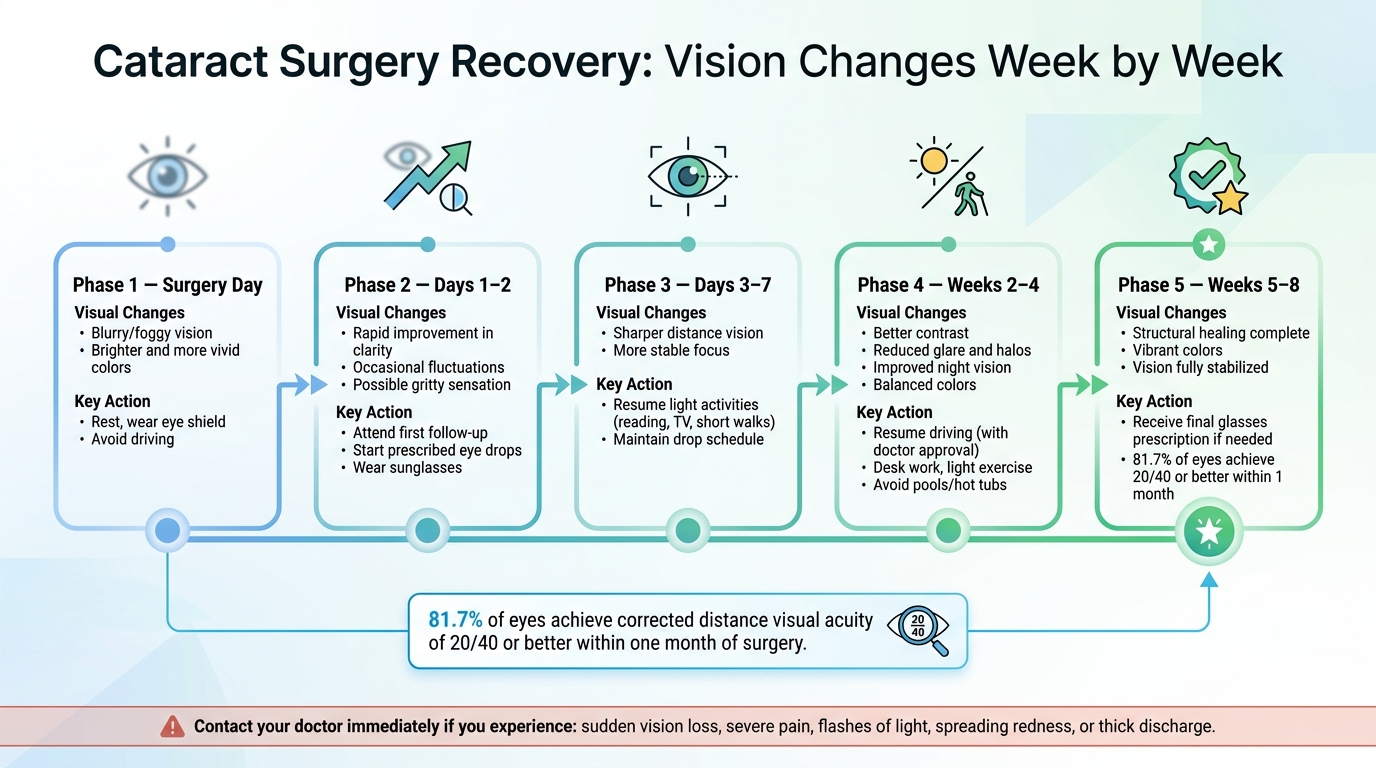
Cataract Surgery Recovery Timeline: Week-by-Week Vision Changes
Recovery after surgery unfolds in distinct weekly phases, each building on the steady progress that begins almost immediately after the procedure.
Week 1: Initial Stabilization
By the end of the first week, the initial haziness typically starts to clear, and vision becomes more stable. Many people find they can comfortably read, watch TV, or manage light household tasks by day seven. Checking a fixed reference point daily can provide reassurance as you notice gradual improvements, signaling that healing is on track.
Week 2: Clearer Vision
During the second week, things start to sharpen. Contrast sensitivity improves, making details clearer, while glare and halos around lights often begin to subside. Light sensitivity decreases, making outdoor activities more enjoyable. By this point, many patients feel ready to resume driving or desk work, provided their doctor has given the go-ahead.
Weeks 3 and 4 bring further refinement to vision, marking the last significant adjustments during the first month.
Weeks 3–4: Continued Progress
Vision continues to stabilize in the third and fourth weeks, with noticeable improvements in night vision and overall clarity. Normal activities, such as driving, working, and light exercise, often become part of your routine again. However, hold off on getting a new glasses prescription until at least 4 to 6 weeks post-surgery. This waiting period ensures your eye measurements have settled, allowing for an accurate fit.
For those with multifocal or extended depth-of-focus (EDOF) intraocular lenses (IOLs), mild visual fluctuations during this time are common. This is due to neuroadaptation, a process where your brain adjusts to the new lens.
| Recovery Phase | Visual Changes | Functional Milestones |
|---|---|---|
| Week 2 | Sharper vision, better contrast, and reduced glare/halos | Resuming activities like reading, light housework, social outings, and driving (with doctor approval) |
| Weeks 3–4 | Stable vision with improved night clarity and balanced colors | Returning to driving, work, and light exercise |
To minimize infection risks, avoid swimming pools and hot tubs through the first month.
Vision Changes After the First Month
Weeks 5–8: Reaching Optimal Vision
Between weeks 5 and 8, most patients find their vision has significantly improved. By this time, structural healing – like the closure of incisions and reduction of swelling – is usually complete, typically by the 6–8 week mark. Many also notice that colors appear more vibrant and sharper than they did before the procedure.
During this period, your doctor will likely provide a final glasses prescription once your vision has stabilized. If only one eye underwent cataract surgery, discussions about scheduling the second eye’s procedure often begin now. However, for individuals with diabetes or those who had particularly dense cataracts removed, the stabilization process might take a little longer. While most visual improvements are evident, some lingering symptoms may still be present.
Dealing With Leftover Visual Issues
Even after the primary healing phase, certain visual concerns might persist. One common issue is dry eye, which affects about 9.8% of patients following phacoemulsification surgery. This can create a gritty sensation or cause minor vision fluctuations. Consistent use of preservative-free artificial tears throughout the day can help manage these symptoms.
Another potential issue is posterior capsule opacification (PCO), often referred to as a "secondary cataract." This happens when the membrane behind the implanted lens becomes cloudy, which can occur in up to 50% of patients within two to five years post-surgery. Fortunately, this condition is easily treated with a simple outpatient procedure called a YAG laser capsulotomy, which restores clarity without the need for traditional surgery.
Patients with multifocal or extended depth-of-focus (EDOF) lenses might still notice mild halos or glare as their brain continues to adjust. This neuroadaptation process can take several months, so it’s important to allow time before considering any further interventions.
When to See Your Eye Doctor
While minor symptoms often resolve on their own, certain signs should prompt immediate attention from your doctor. Contact your provider without delay if you experience any of the following:
- Sudden vision loss or vision that becomes patchy or dark
- A sudden increase in floaters or flashes of light
- Spreading redness or thick discharge
- Persistent eye pain or a feeling of increased pressure
- Fever or chills alongside eye symptoms
"If your vision goes backward instead of forward, call us." – Dr. Rupa Wong, Pediatric Ophthalmologist and Surgeon
These symptoms could indicate rare but serious complications, such as retinal stress or infection (endophthalmitis), which occurs in 0.04% to 0.2% of cases. Always prioritize your eye health and seek professional advice if something feels off.
How Eye Center of Northern Colorado Supports Your Recovery

Postoperative Follow-Up Care
Recovery doesn’t end when you leave the operating room. The Eye Center of Northern Colorado ensures your healing journey continues smoothly with personalized follow-up care. The duration of these follow-ups depends on the type of intraocular lens (IOL) you’ve chosen: 90 days for standard monofocal IOLs and 180 days for toric, multifocal, and Light Adjustable Lenses (LAL). During these visits, the team closely monitors your progress, makes any necessary adjustments to your medication, and promptly addresses concerns to keep your recovery on track.
At home, you’ll continue standard protective measures to safeguard your healing eyes. Beyond these check-ins, additional optical services and adjustments are available to further refine your vision.
Help With IOL Adjustment
If you’ve opted for the Light Adjustable Lens (LAL), the recovery process includes a unique customization step. Starting about 2–4 weeks after surgery, your doctor uses a Light Delivery Device (LDD) to fine-tune your lens using UV light. This allows for precise adjustments based on how your vision performs in your day-to-day life.
"You and your surgeon can adjust the lens to optimize your vision based on your unique preferences and lifestyle requirements. This allows you to achieve a vision that is truly tailored just for you." – Eye Center of Northern Colorado
The process typically involves 1–3 light treatments, spaced at least three days apart, followed by two final lock-in sessions. During this period, wearing UV-protective glasses outside the office is mandatory until the lens adjustments are finalized.
For those with multifocal or extended depth-of-focus (EDOF) lenses such as Panoptix or Vivity, the team provides guidance on managing potential side effects like halos or mild glare. These effects often diminish over time as your brain adapts, typically within a few months.
Optical Services for Updated Vision Needs
Even after surgery, some patients may require corrective lenses. By the one-month mark, when vision has usually stabilized, the team can finalize a new eyeglass prescription if needed. However, premium lenses like Panoptix or Vivity are designed to potentially eliminate the need for glasses altogether.
"Our cataract surgery patients receive the benefit of a full range of vision with Active Lifestyle Lenses… They can live their lives lens-free; that means no glasses or contacts needed to play water sports, read, knit, drive, or any daily activity." – Eye Center of Northern Colorado
For added convenience, optical services are accessible at multiple locations, including Longmont, Boulder, Lafayette, and Greeley.
Conclusion: What to Remember About Cataract Surgery Recovery
Recovering from cataract surgery requires patience and care. While most people experience visual stabilization between 4–8 weeks after surgery, about 81.7% of eyes achieve a corrected distance visual acuity of 20/40 or better within a month. This aligns with the recovery milestones discussed earlier.
In the early days, symptoms like blurriness, light sensitivity, and a gritty feeling are common as your eyes adjust. This process, known as neuroadaptation, is especially noticeable for those with premium multifocal or EDOF lenses. Staying patient and following your recovery plan is key to achieving the best results.
Make sure to attend all your follow-up appointments. As the Southwest Eye Institute explains:
"Your follow-up appointments are not routine – they’re protective. Even when vision seems clear, your doctor is monitoring subtle changes that you can’t feel or see." – Southwest Eye Institute
These visits help your doctor catch any potential issues early, even if your vision feels fine. To support a smoother recovery, stick to your prescribed eye drop schedule, avoid lifting anything over 30 lbs., and protect your eye from irritants like pool water or dust. Long-term follow-ups are also essential to address concerns like posterior capsule opacification (PCO).
FAQs
When will my vision stop fluctuating after cataract surgery?
Vision changes are a common part of the healing process as your eye adapts to the new intraocular lens. Most people see noticeable improvement within just a few days, though it can take about 4–8 weeks for your vision to fully stabilize. If you’ve opted for multifocal or premium lenses, your eyes may require extra time to adjust as your brain learns to process the new visual input. At the Eye Center of Northern Colorado, your recovery is carefully monitored during follow-up visits to make sure everything is on track.
How do I know if my symptoms are normal or an emergency?
Mild irritation, changes in vision, and dryness are common during recovery. But if you notice worsening pain, pronounced redness, sudden vision loss, or see flashes of light or floaters, contact your surgeon immediately – these could signal a serious issue. Stay vigilant about your symptoms, and don’t hesitate to seek prompt care if something feels off or doesn’t improve.
What can delay vision recovery after cataract surgery?
After cataract surgery, vision recovery can sometimes take longer than expected. This delay may stem from individual healing variations, pre-existing eye conditions, or your eyes’ unique response to the recovery process. It’s also normal to experience temporary issues like dryness, irritation, or fluctuations in vision during this time. However, if recovery seems unusually prolonged, it’s a good idea to reach out to your eye care provider for advice.