Continuous eye-pressure monitoring can show changes that office tests miss – but more data does not always mean better care. When glaucoma worsens despite stable office readings, extra monitoring may help check for pressure peaks across 24 hours. Results still need review alongside optic-nerve exams, OCT scans, and visual-field tests.
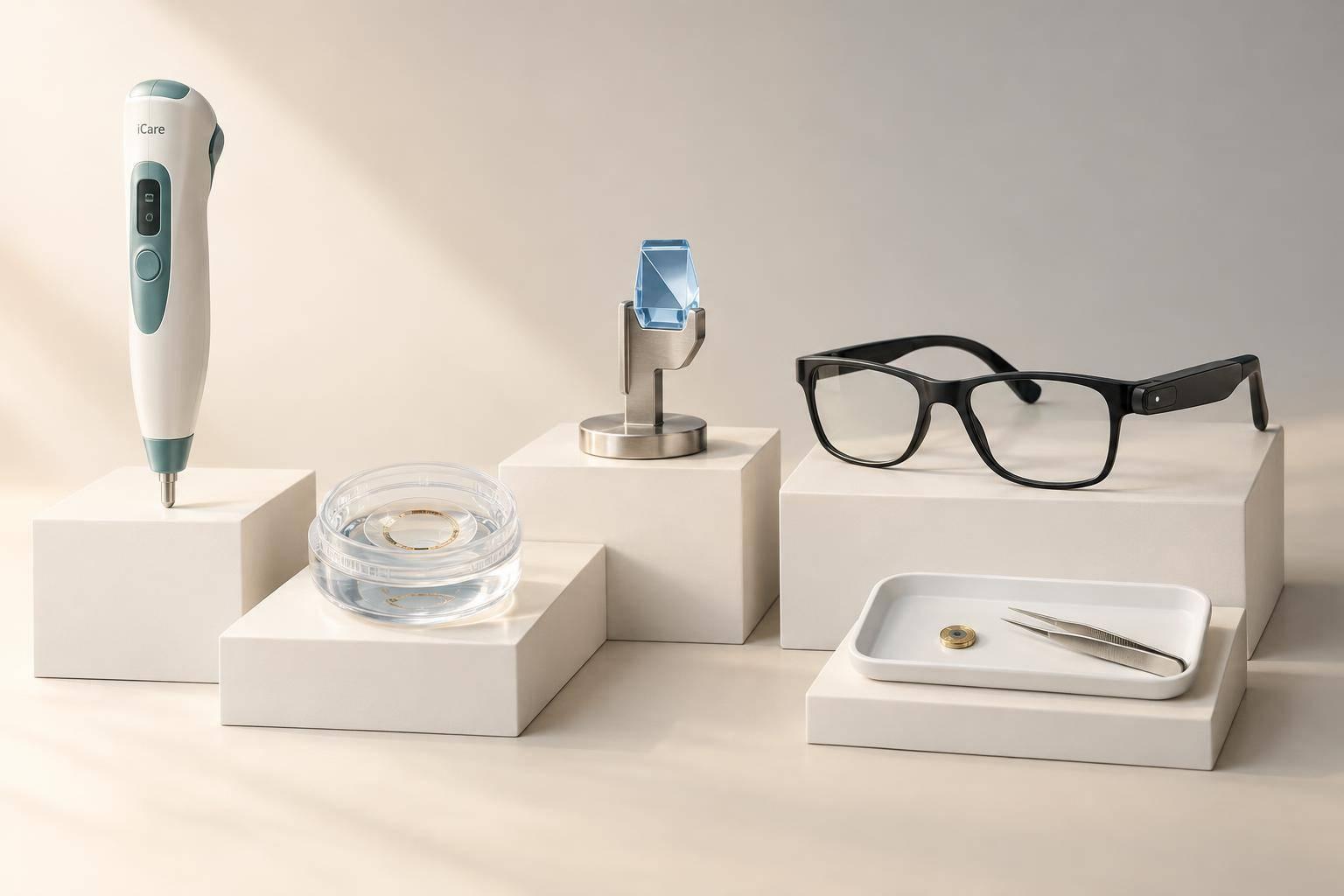
The five options differ in coverage, accuracy, and care burden. Some report pressure in millimeters of mercury (mmHg); others show only pressure-related patterns.
Quick Comparison
| Method | Coverage | Measurement limits | Care burden |
|---|---|---|---|
| Goldmann applanation tonometry | One office snapshot | Reports mmHg; corneal properties affect readings | Office visits |
| Repeated office measurements | Several scheduled snapshots | Shows some daytime changes, not a full 24-hour pattern | Extra visits and costs |
| Home self-tonometry | Patient-initiated checks | Reports mmHg; depends on technique | Equipment, training, and clinician review |
| Contact-lens sensors | Daytime and overnight recording during wear | Tracks indirect signals, not direct mmHg readings | Fitting, comfort, cost, and data review |
| Implantable sensors | Device-dependent, longer-term monitoring | Accuracy can drift; some require a nearby reader for every reading | Surgery, reader access, and follow-up |
The right choice depends on whether extra readings could change treatment. Device accuracy, comfort, surgical risks, cost, and insurance coverage all matter. No monitoring method replaces regular glaucoma exams or proves, by itself, that long-term vision will improve.
IOP Monitoring: Compare 5 Methods
1. Goldmann Applanation Tonometry
Pressure-Pattern Coverage
GAT is the standard office test, but it provides only one daytime snapshot. It can miss pressure spikes at night or between visits. A brief spike may end before your appointment and go undetected.
Measurement Accuracy
Corneal thickness can affect GAT readings and is also linked to glaucoma risk. Ask whether your corneal thickness was measured and how it affects the interpretation of your intraocular pressure (IOP) reading.
Clinical Use and Patient Burden
Clinicians use GAT to set and adjust a target pressure. Getting more readings requires repeat clinic visits, which means additional appointments.
When a single reading isn’t enough, repeated office measurements can help show whether pressure is stable or changing.
sbb-itb-5ef6ec9
Lecture: Towards Constant Measurement of IOP: Dr. Malik Y. Kahook
2. Repeated Office Measurements
One office reading may not tell the whole story. Repeated checks help show whether eye pressure stays steady or changes over time.
Pressure-Pattern Coverage
Readings across several visits give clinicians more than a single office snapshot. But they still miss overnight spikes and the true 24-hour peak.
Measurement Accuracy
Repeated readings make trends easier to spot, but each measurement is still a snapshot. Clinicians must interpret these results alongside OCT and visual field testing.
Clinical Use and Patient Burden
To assess change, clinicians need the patient’s current eye drop list and previous visual field results. Extra visits also mean more travel, time, and out-of-pocket costs.
When office visits leave gaps, home self-tonometry can provide readings between appointments.
3. Home Self-Tonometry
Pressure-Pattern Coverage
Home self-tonometry lets patients measure eye pressure between visits. Scheduled checks can reveal changes, but they may still miss overnight spikes and brief swings.
Measurement Accuracy
Accuracy depends on training, positioning, and consistent technique. Poor positioning can distort trends, and home readings should not be assumed to match Goldmann applanation tonometry.
Clinical Use and Patient Burden
This option suits patients who can self-test reliably and share their results for review. Home checks may help record large fluctuations or sudden intraocular pressure (IOP) spikes, which can cause blurred vision, halos, or eye pain. Discuss device cost, reliability, and the follow-up needed to interpret readings.
For more continuous coverage, contact-lens sensors collect pressure-related data more often than scheduled home checks.
4. Contact-Lens Sensors
Contact-lens sensors provide overnight pattern data for patients who need more nighttime information than scheduled home checks offer.
Pressure-Pattern Coverage
These sensors record pressure-related patterns through the night, filling gaps that office snapshots and scheduled home checks can leave.
Measurement Accuracy
One example, SENSIMED Triggerfish, uses a sensor in a silicone lens to detect corneal shape changes linked to IOP shifts.
These sensors track trends – not direct pressure readings in mmHg.
Clinical Use and Patient Burden
Clinicians use the readings to assess whether nighttime variation needs further review. Patients should discuss comfort, safety, wear limits, and cost.
5. Implantable IOP Sensors
When office tests and external sensors leave gaps, implantable devices can extend monitoring further into follow-up care.
Pressure-Pattern Coverage
Passive telemetric implants do not stream continuously. They transmit data only when an external reader held near the eye powers them.
Longer monitoring helps only if the device stays accurate over time.
Measurement Accuracy
Accuracy and calibration needs differ by device. Ask how readings will be checked against Goldmann applanation tonometry, whether the device needs calibration, and how follow-up checks will detect drift – gradual error over time.
Clinical Use and Patient Burden
Implantation requires surgery. Some devices are placed during cataract surgery; others need a separate procedure. The tradeoff: more data, but also surgery and its risks.
Weigh the added monitoring against possible pressure increases, iris inflammation, dry eye, pain, redness, or visual-field loss. Before deciding, confirm what reader the device requires, the follow-up visit schedule, total cost, and U.S. regulatory status.
Comparing Coverage, Accuracy, and Care Needs
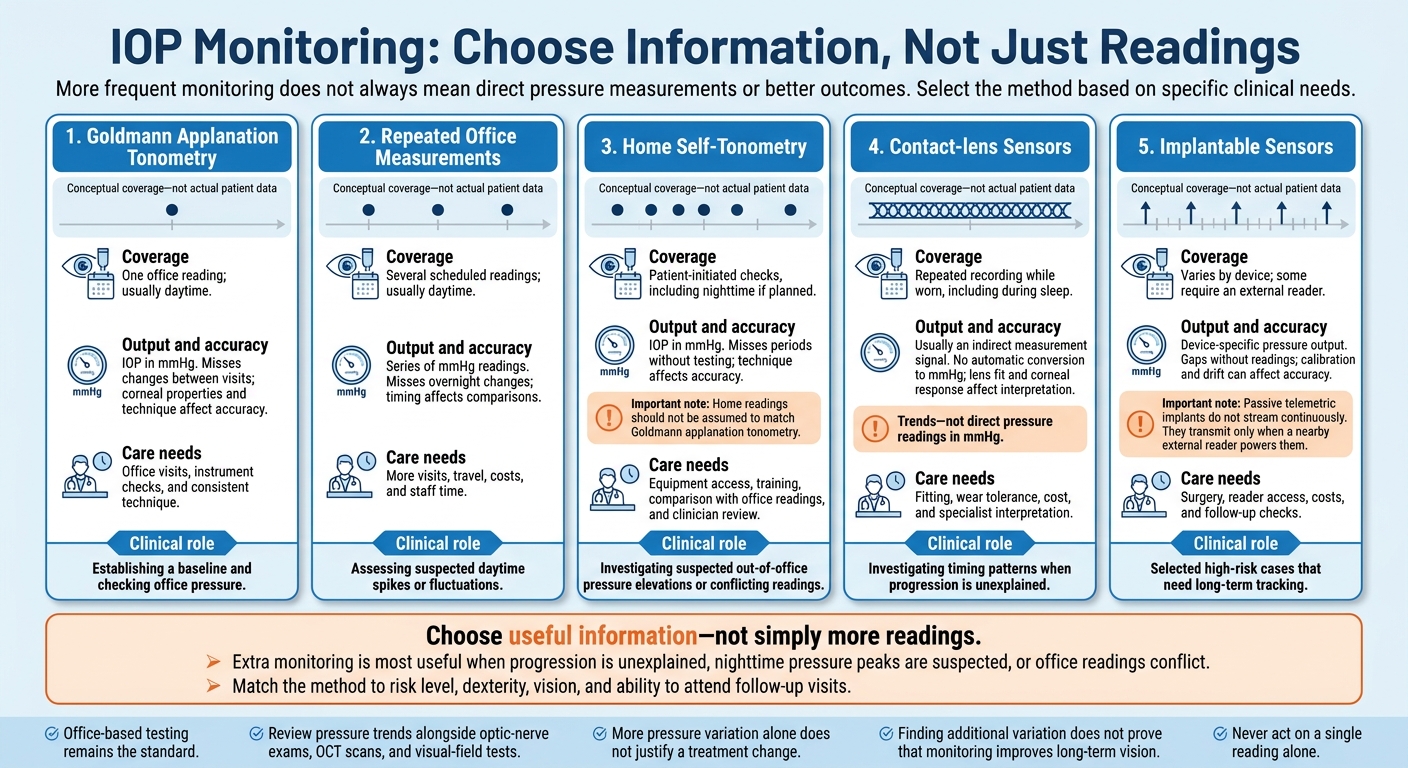
The comparison below shows how each method differs in coverage, accuracy, and patient burden. More monitoring usually comes with higher costs, more complexity, or indirect measurements.
Daytime and Nighttime Coverage
Coverage depends on when readings are taken.
| Method | Coverage | Output Type | Key Limitation | Care Burden |
|---|---|---|---|---|
| Goldmann applanation tonometry | One office reading; usually daytime | IOP in mmHg | Misses changes between visits; corneal properties and technique affect accuracy | Office visits, instrument checks, and consistent technique |
| Repeated office measurements | Several scheduled readings; usually daytime | Series of mmHg readings | Misses overnight changes; timing affects comparisons | More visits, travel, costs, and staff time |
| Home self-tonometry | Patient-initiated checks, including nighttime if planned | IOP in mmHg | Misses periods without testing; technique affects accuracy | Equipment access, training, comparison with office readings, and clinician review |
| Contact-lens sensors | Repeated recording while worn, including during sleep | Usually an indirect measurement signal | No automatic conversion to mmHg; lens fit and corneal response affect interpretation | Fitting, wear tolerance, cost, and specialist interpretation |
| Implantable sensors | Varies by device; some require an external reader | Device-specific pressure output | Gaps without readings; calibration and drift can affect accuracy | Surgery, reader access, costs, and follow-up checks |
Measurement Accuracy and Interpretation
Not all devices report the same type of measurement. Goldmann applanation tonometry and home tonometry report mmHg directly. Contact-lens sensors generally provide indirect signals. Implantable sensors need device-specific interpretation and may report mmHg.
Corneal thickness still affects interpretation. OCT and visual fields remain necessary for tracking progression.
Treatment Decisions, Safety, and Costs
Choosing a device means weighing what it measures against the time, risks, and follow-up it requires.
More pressure variation alone does not justify a treatment change. Finding additional variation does not prove that monitoring improves long-term vision. Treatment decisions should combine pressure trends with evidence of optic-nerve damage and an individualized target IOP.
If cost is a concern, ask for a written estimate in U.S. dollars. Confirm insurance coverage and authorization requirements in advance. For remote-monitoring systems, ask who reviews the data and how soon someone acts on urgent results.
Benefits, Limits, and Patient Selection
Extra monitoring is most useful when progression is unexplained, nighttime pressure peaks are suspected, or office readings conflict. Patients whose pressure is stable on drops or laser, with stable optic nerve and visual-field findings, can continue office-based monitoring.
The choice isn’t just about what each method measures. It’s about which patient needs more data.
| Method | Principal Benefit | Corresponding Limitation | Potential Clinical Role |
|---|---|---|---|
| Goldmann applanation tonometry | Provides a direct office baseline in mmHg | Measures one point in time, leaving gaps | Establishing a baseline and checking office pressure |
| Repeated office measurements | Records some daytime IOP variation | Requires more visits and misses overnight patterns | Assessing suspected daytime spikes or fluctuations |
| Home self-tonometry | Allows evening and early-morning measurements | Requires training; technique errors and missed readings can distort trends | Investigating suspected out-of-office pressure elevations or conflicting readings |
| Contact-lens sensors | Provides overnight trend data during wear | Data can be hard to interpret, and wear tolerance is limited | Investigating timing patterns when progression is unexplained |
| Implantable sensors | Provides long-term data without daily self-testing | Requires surgery, follow-up, and a device-specific reader | Selected high-risk cases that need long-term tracking |
The same device may help one patient but add little for another. Match the method to risk level, dexterity, vision, and ability to attend follow-up visits.
Before choosing home testing, discuss whether the patient’s vision, hand control, and schedule allow reliable use. Corneal health, ocular surface tolerance, and comfort also matter. For implantable sensors, assess surgical suitability separately – a preference for more data isn’t enough. Weigh the added testing burden against whether the results are likely to change care.
Conclusion: Choosing a Monitoring Plan
Choose a monitoring plan that balances coverage, accuracy, and the burden of use. Continuous IOP monitoring can add to office care, but office-based testing remains the standard. Check that the device is validated, arrange training or professional fitting if needed, and decide who will review the results. Set a target pressure and put instructions for abnormal readings in writing, including when to contact the clinician.
Review pressure trends alongside optic-nerve findings, OCT, visual fields, medication history, and documented progression. Never act on a single reading alone.
Continuous monitoring isn’t a universal replacement for office care. Sensor accuracy, shared data standards, implant safety, cost, insurance coverage, and uncertain long-term outcome benefits all need review before adding it to a care plan.
For a glaucoma evaluation and a monitoring plan matched to your risk and follow-up needs, contact Eye Center of Northern Colorado.
FAQs
How long should I monitor my eye pressure at home?
Eye pressure monitoring is a lifelong part of glaucoma care and helps prevent permanent vision loss. Glaucoma is a chronic condition that often has no symptoms. Regular checks help your provider see whether your pressure is within a safe range to protect your optic nerve – even during treatment.
Talk with your Eye Center of Northern Colorado provider about your specific monitoring needs.
What should I do if home and office readings differ?
If your eye pressure (intraocular pressure) readings differ at home and in the office, bring your home monitoring data to your next ophthalmologist appointment. Contact your ophthalmologist sooner if you’re worried about pressure spikes or have symptoms such as blurred vision, halos, or eye pain.
Your doctor can check whether these differences are part of normal daily changes or mean your treatment plan needs to change.
Which eye-pressure changes need urgent attention?
A sudden increase in intraocular pressure (pressure inside the eye) or large swings in pressure may need urgent attention. Symptoms can include eye pain, pressure around the eye, blurred vision, or halos around lights. In closed-angle glaucoma, a sudden pressure increase can cause immediate vision loss and severe pain.
If you have these symptoms or sudden vision changes, contact the Eye Center of Northern Colorado right away for an evaluation.