Using glaucoma eye drops correctly is crucial for managing eye pressure and protecting your vision. Many people struggle with proper application, which can reduce the effectiveness of the medication. Here’s a quick guide to help you maximize the benefits of your treatment:
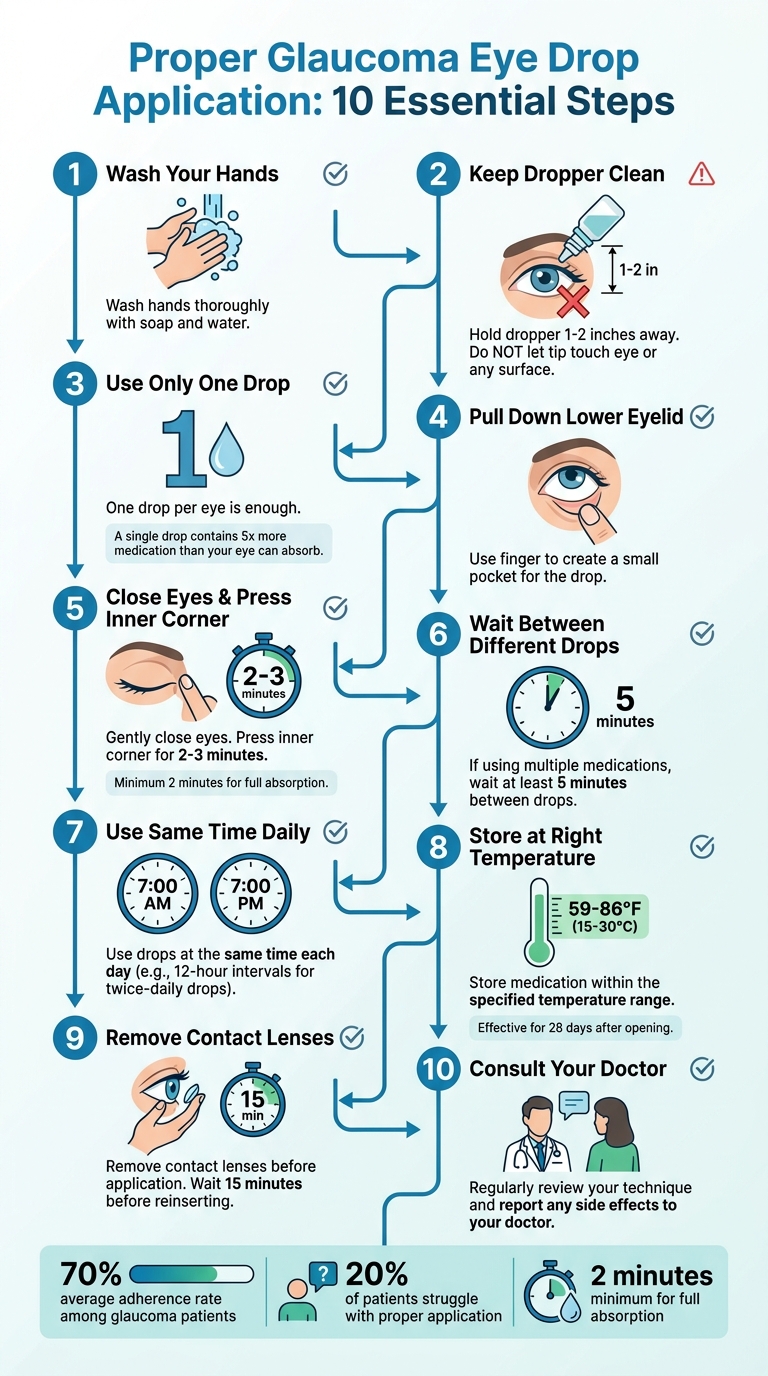
- Wash your hands before and after applying drops to avoid infections.
- Keep the dropper tip clean and avoid touching it to your eye or any surface.
- Use only one drop per eye – more doesn’t improve results and wastes medication.
- Pull down your lower eyelid to create a pocket for the drop.
- Close your eyes and press the inner corner for 2 minutes to help absorption.
- If using multiple drops, wait 5 minutes between applications to avoid dilution.
- Stick to a consistent schedule to maintain steady medication levels.
- Store drops at the right temperature to preserve their effectiveness.
- Remove contact lenses before use and wait 15 minutes before reinserting them.
- Talk to your doctor about your technique and any side effects.
These steps help ensure the medication works as intended, reducing eye pressure and protecting your vision over time. If you’re struggling with application or experiencing side effects, consult your doctor for guidance.
How to Apply Glaucoma Eye Drops Correctly: Step-by-Step Guide
Using Eye Drops to Treat Glaucoma
sbb-itb-5ef6ec9
1. Wash Your Hands Before Applying Drops
Keeping your hands clean is essential to avoid eye infections when using glaucoma drops. Before handling the dropper, wash your hands thoroughly with soap and water. This simple step helps prevent bacteria from transferring to the dropper and, ultimately, to your eye.
"Dirty hands can result in eye infections which may be serious." – Alan L. Robin, MD
When you apply the drops, your fingers will likely touch your eye as you pull down the lower eyelid. Clean hands reduce the chance of introducing bacteria during this process. Every time you touch your eye, there’s a risk of contamination, so it’s important to keep unnecessary contact to a minimum.
If someone else is helping you apply the drops, they should also wash their hands beforehand.
Finally, wash your hands again after applying the drops. This removes any residue from the medication, which could cause unintended side effects if it comes into contact with your mouth or other areas.
2. Keep the Dropper Tip Clean
After washing your hands, it’s important to ensure that the dropper tip stays uncontaminated. Avoid letting the tip touch your eye or any surfaces, as this could lead to bacterial contamination. If the tip comes into contact with an external surface, bacteria might transfer into the bottle, potentially compromising the sterility of the medication and making it unsafe to use.
"Be careful not to touch the bottle to your eye as this can transfer bacteria to the bottle tip." – Glaucoma Research Foundation
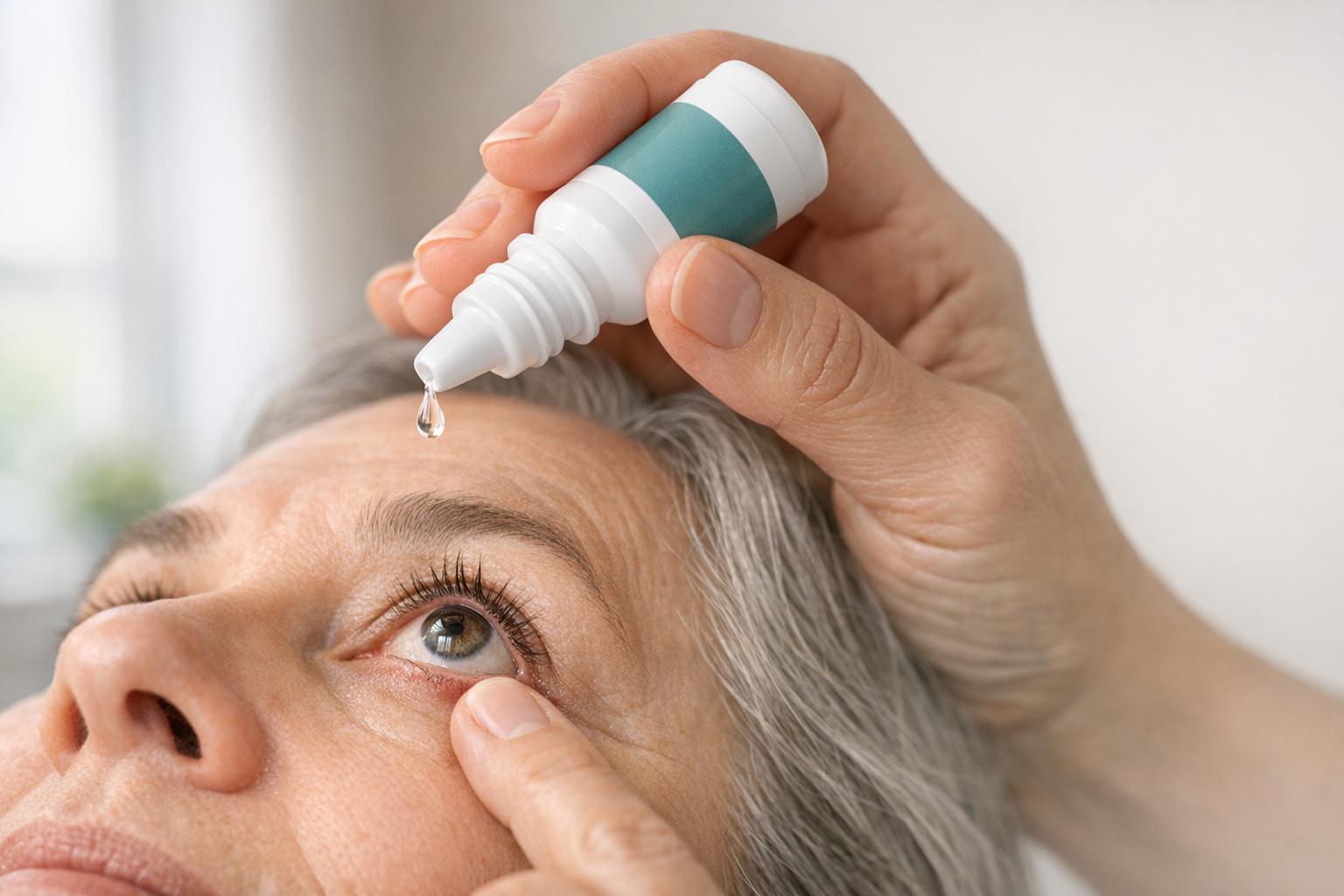
When applying eye drops, hold the bottle about one to two inches above your eye. This distance allows the drop to fall into your eye while keeping the tip safely away. If you find it hard to keep your hand steady, try resting it against your forehead for extra support.
Always replace the cap immediately after using the drops to protect the tip from contaminants. This simple step is as crucial as washing your hands, as it helps maintain the medication’s effectiveness and prevents infections.
"Make sure you don’t touch the eye itself or any other surface to avoid any cross contamination." – Community Pharmacist Khanh Nguyen, Glaucoma Australia
Keeping the dropper tip clean throughout the bottle’s usage ensures your treatment remains both effective and safe.
3. Use Only One Drop Per Eye
When it comes to eye drops, one drop per eye is all you need. Your eye can only hold a limited amount of fluid, and most commercial eye drops already exceed that capacity. Adding extra drops doesn’t help – it just spills over onto your cheek, wasting medication.
"Only one drop is needed, not two, even if the bottle says, ‘one drop or two.’" – Bradley L. Schuster, MD, Glaucoma Specialist
Using more than one drop doesn’t improve effectiveness or further reduce eye pressure. In fact, a single drop typically contains five times more medication than your eye can absorb. Overdosing can lead to excess medication draining through your tear ducts, which may enter your bloodstream and cause side effects like dizziness or difficulty breathing.
To maximize the benefit of each drop, make sure you’re applying it correctly. Proper head positioning can help with absorption, ensuring the medication stays where it’s needed. This small adjustment can make a big difference in managing glaucoma effectively.
4. Pull Down Your Lower Eyelid
Using your lower eyelid as a pocket can help keep the medication in place. With your free hand, gently pull down your lower lid using your index finger or thumb. This creates a small pocket between your lid and eyeball – a perfect spot for catching the drop and stopping it from rolling down your cheek.
"The eye drop will be effective if it lands on either the eyeball, or in the pinkish inside surface of the lower lid." – Glaucoma Research Foundation
Pulling down your lid also gives you a larger target, making it easier to aim. Look upward to expose more of the white part of your eye, and aim toward the side near your nose instead of the temple. Drops that land closer to your temple are more likely to roll out before being absorbed.
Once the drop lands in the pocket, gently close your eye for about 60 seconds to allow the medication to absorb. If the drop ends up on your lashes or skin instead of the pocket, it won’t work effectively, so you’ll need to try again.
For better control, rest your hand against your forehead to keep your aim steady.
5. Close Your Eyes and Press the Inner Corner
After applying the eye drop, resist the urge to blink repeatedly. Instead, gently close your eyes and keep them closed. Then, use your fingertip to softly press the inner corner of your eye near your nose. This simple step helps block the tear drainage system, ensuring the medication stays on the eye’s surface where it’s needed.
"Once the drop is on the eye, do not blink your eye or move it around to spread the drop. Instead, gently close your eyes just once, place the pad of your most sensitive finger at the inside corner of the eyelid by the nose and press gently." – Glaucoma Research Foundation
Hold this position for 2 to 3 minutes. Research suggests that at least 2 minutes is necessary for the medication to be fully absorbed. Using a timer can help you keep track of the time.
This technique not only improves the absorption of the medication but also reduces the chance of systemic side effects by preventing the drug from draining through the tear ducts.
Once the time is up, use a clean tissue to carefully dab away any excess medication from your eyelids. This helps prevent irritation to the surrounding skin. Following this method ensures the eye drop is absorbed effectively before moving on to the next step.
6. Wait 5 Minutes Between Different Eye Drops
If you’ve been prescribed more than one type of glaucoma medication, timing is everything. Applying a second drop too soon can dilute or wash away the first one before it’s fully absorbed. This is something many patients might not realize, but it’s crucial for the effectiveness of your treatment.
Here’s why timing matters: Each drop fills your eye to its capacity. Adding another drop immediately doesn’t just waste medication – it reduces the impact of the first one. As Dr. Rob Schertzer points out:
"Because the volume of a single drop exceeds the capacity of the surface of the eye, it serves no purpose to use two drops at the same time".
And according to Bradley L. Schuster, MD, a glaucoma specialist:
"Studies have shown that it takes 2 full minutes for the drop to completely penetrate the surface of the eye to get inside".
To ensure each medication works as intended, give it time to absorb. The National Eye Institute advises:
"If you need to use more than 1 type of eye drop… wait at least 5 minutes between each type".
Using a timer on your phone can help you stick to the 5-minute rule. The order of the drops isn’t critical, but the waiting period is. This small pause ensures each drop is as effective as possible, setting you up for the best results.
7. Use Your Drops at the Same Time Each Day
Consistency is key when it comes to managing glaucoma and preventing vision loss. Using your eye drops at the same time every day ensures that medication levels in your eyes remain steady, which is critical for keeping eye pressure under control 24/7. Skipping doses or inconsistent timing can lead to pressure spikes, potentially causing irreversible damage.
The reality is, many patients struggle to stick to a routine. On average, glaucoma patients use only 70% of their prescribed drops, and less than half are still using them consistently by the end of the first year. Even when patients believe they’re following instructions, studies show adherence often hovers around that 70% mark. As the Wilmer Glaucoma Center of Excellence explains:
"If you don’t have an iron-clad reminder system, you will forget".
To build a habit, tie your drop schedule to daily activities like brushing your teeth or having your morning coffee. For drops that need to be applied twice a day, aim for a 12-hour interval – something like 7:00 AM and 7:00 PM – so the medication provides continuous coverage. This regular timing complements proper application techniques, maximizing the treatment’s effectiveness.
Tools like recurring alarms or visual reminders can help. Place the bottle somewhere you’ll see it, like near your toothbrush or coffee maker. A simple calendar next to the bottle can also work – mark an "X" after each dose to track your progress and spot any missed times. The Wilmer Glaucoma Center underscores this point:
"The secret to preventing vision loss is to be consistent and to take drops every day in between doctor visits".
If you do miss a dose, don’t panic – take it as soon as you remember, but avoid doubling up. Your vision depends on your daily habits, not just what you do leading up to your next appointment. Sticking to a regular schedule strengthens your entire treatment plan and gives you the best chance of maintaining your sight.
8. Store Drops at the Right Temperature
Keeping your eye drops at the right temperature is essential for maintaining their effectiveness. Most pharmaceutical companies recommend storing them between 59°F and 86°F (15°C to 30°C) to prevent the active ingredients from breaking down and becoming less effective. As glaucoma specialist Dr. Gail F. Schwartz explains:
"Most pharmaceutical companies recommend storing medications at temperatures between 59-86° Fahrenheit".
When exposed to extreme temperatures, not only can the drops lose their effectiveness, but they may also cause side effects like irritation or redness.
Some medications, such as unopened bottles of latanoprost, may need refrigeration to stay effective. Always check the package insert or label for specific storage instructions. Community pharmacist Khanh Nguyen provides helpful guidance:
"Sometimes your eye drops may be refrigerated at the pharmacy but once you take them home, you can store them in a cool dry area outside of the fridge".
If your drops require refrigeration, let the bottle sit at room temperature for a few minutes before use. This can help avoid the discomfort of applying cold drops.
Be mindful of where you store your eye drops. Avoid places exposed to direct sunlight or areas where temperatures can fluctuate, such as near windows or in cars. When traveling, especially by air, keep your drops in your carry-on bag to avoid extreme temperature changes. For those in hot climates, consider using cooling pouches that can maintain safe temperatures for over 40 hours without needing refrigeration.
Finally, remember that most glaucoma eye drops are effective for only about 28 days after opening. Check expiration dates regularly, and discard any old bottles to ensure you’re using medication that works as intended. Proper storage is a simple but important part of your glaucoma care routine.
9. Remove Contact Lenses Before Using Drops
If you wear contact lenses, it’s important to take them out before applying your glaucoma eye drops. Why? Contact lenses can interfere with how the medication is absorbed by your eye, potentially reducing its effectiveness in managing eye pressure. Plus, lenses can soak up the medication or its preservatives, which might damage the lenses or irritate your eyes. Community pharmacist Khanh Nguyen highlights this key practice:
"If you are a contact lens wearer, it is important to always remove your lenses before you insert any eye drops. You should then wait about 15 minutes before you insert them again."
That 15-minute wait after using your drops is critical. It gives your eyes enough time to fully absorb the medication and avoids any unwanted reactions between the drops and your contacts. If you’re using more than one type of eye drop, follow the recommended wait time between applications (usually 3–10 minutes), then wait 15 minutes after the last drop before putting your lenses back in. This routine helps ensure the medication works as intended and reduces the chance of complications with your lenses.
The one exception? Lubricating eye drops specifically made for dry eye relief – these are generally safe to use while wearing contacts. To make sticking to the timing easier, try setting a timer on your phone as a reminder.
For personalized advice on your glaucoma treatment and eye drop schedule, reach out to your eye care provider at Eye Center of Northern Colorado (https://eyecenternoco.com).
10. Talk to Your Doctor About Technique and Side Effects
It’s important to have your doctor occasionally check how you’re applying your eye drops. Many people unknowingly make simple mistakes that can reduce the medication’s effectiveness. At your next visit, ask your doctor or a technician to watch as you apply a drop. They can spot common errors like blinking too soon, moving your eye, or holding the bottle at the wrong angle.
"Make sure that you have a friend or your doctor watch you instill the drop in your eye. If you are having problems, ask your doctor or your doctor’s technician for help." – Alan L. Robin, MD, Professor of Ophthalmology
Discuss nasolacrimal occlusion (gently pressing on the corner of your eye near the nose) with your doctor. This technique helps prevent the medication from draining into your bloodstream through the tear duct, which can reduce potential side effects. Reviewing your technique regularly reinforces the steps needed for effective treatment.
If you’re experiencing side effects – whether local ones like redness, stinging, or blurred vision, or systemic ones like dizziness, breathing issues, or an irregular heartbeat – report them to your doctor immediately. They may adjust your dose, switch you to a different medication, or suggest alternatives with fewer preservatives. If applying the drops on your own continues to be a challenge, ask about other treatments, such as laser therapy.
Keeping a symptom diary can also be useful. It helps your doctor understand how you’re responding to the treatment. If you’re running out of medication earlier than expected due to application difficulties, inform your pharmacy. Medicare and many states require pharmacies to provide extra refills for eye drops in such cases.
Getting professional feedback and staying open about challenges with your treatment plan can make a big difference. The goal is to find a routine that works for you and keeps your eye pressure under control.
For personalized advice on managing glaucoma and improving your application technique, consider scheduling an appointment with the Eye Center of Northern Colorado (https://eyecenternoco.com).
Conclusion
Using glaucoma eye drops correctly is essential for managing eye pressure and protecting your vision. These medications are designed to lower and maintain intraocular pressure at a healthy level, helping to prevent vision loss over time. But they only work effectively when applied the right way.
To ensure proper absorption, allow at least 2 minutes after applying the drops. Close your eyes gently and press the inner corner to minimize drainage and potential side effects. If you’re using multiple types of drops, wait at least five minutes between applications to give each medication time to work.
Interestingly, about 20% of patients struggle with applying their drops correctly. If you’re having trouble, professional guidance can make a big difference. As the Glaucoma Research Foundation emphasizes:
"Prescription eye drops for glaucoma help maintain the pressure in your eye at a healthy level and are an important part of the treatment routine for many people".
The Eye Center of Northern Colorado provides comprehensive glaucoma care with specialists trained to help you. They can demonstrate proper drop application techniques, review your current routine, and address any concerns about side effects or medication effectiveness. Their goal is to create a treatment plan tailored to your needs.
If you’re facing challenges with your eye drop routine, visit the Eye Center of Northern Colorado at https://eyecenternoco.com for expert support. By following these tips and seeking personalized care, you can take control of your glaucoma management.
FAQs
What should I do if I miss a dose?
If you forget to use your glaucoma eye drops, apply them as soon as you remember. However, if it’s close to your next scheduled dose, just skip the missed one and continue with your usual routine. Never use extra drops to make up for the missed dose – this could lead to unwanted side effects.
How can I tell if my eye drop technique is working?
You can check if your eye drop technique works by ensuring the drop actually reaches your eye. One trick is to refrigerate the bottle – the cool sensation lets you know the drop made contact. To apply eye drops correctly, gently pull down your lower eyelid, hold the bottle about an inch above your eye, squeeze out a single drop, and then close your eye for about two minutes. If you notice symptom relief or a decrease in eye pressure, that’s another sign you’re doing it right.
When should I call my doctor about side effects?
If you notice severe or ongoing side effects from glaucoma eye drops – like worsening dryness, allergic reactions, intense redness, breathing difficulties, an irregular heartbeat, depression, or dizziness – reach out to your doctor right away. Even if the side effects seem mild, it’s important to let your doctor know about them. This helps ensure you’re getting the right care and staying safe. Always follow your doctor’s guidance carefully to manage your condition effectively.