
Most people do not need blue light glasses for eye health. If you use screens a lot, the bigger issues are often dry eyes, less blinking, long focus time, and poor screen setup. For sleep, blue light matters more at night, and amber or darker lenses may help some people before bed.
Here’s the short version:
- Blue light from screens is low compared with daylight
- Research does not show clear proof that blue light lenses reduce eye strain
- Sleep is the main reason some people try them, especially in the evening
- Clear lenses block less blue light and change color less
- Amber and orange lenses block more, but they also tint your vision more
- AR coating, screen distance, and the right prescription often matter more for comfort than blue light filtering alone
- In the U.S., blue light coatings often cost about $17 to $50, while full glasses can cost $100 to $300+
If I were choosing, I’d keep it simple: for daytime screen work, I’d focus on screen breaks, monitor position, blinking, and updated prescription lenses. If sleep is the issue, I’d look at evening screen limits, night mode settings, or amber lenses before bed.
| Option | Best for | Main tradeoff |
|---|---|---|
| Clear blue light lenses | All-day wear, office use | Lower blue light filtering |
| Amber/yellow lenses | Evening screen use, sleep support | More yellow tint |
| Dark orange/red lenses | Maximum evening light blocking | Strong color shift |
That’s the core of it. The rest of this guide helps you sort through the claims, lens types, costs, and what to ask before you buy.
How Blue Light Affects Vision, Comfort, and Sleep
Blue Light, Circadian Rhythm, and Evening Screen Use
Blue light matters most at night. Sunlight in the morning helps set your body clock and suppresses melatonin, which is part of a normal sleep-wake cycle. The problem tends to show up later in the day.
Blue light exposure within 2–3 hours of bedtime can suppress melatonin production and delay sleep. In a 2022 Harvard Medical School study, people exposed to blue light before bed took 30% longer to fall asleep than those who were not. So yes, blue light can affect sleep. But when people talk about screen discomfort, dry eye and focusing fatigue are often the bigger issues.
A simple fix? Turn on Night Shift or Night Light 2–3 hours before bed, or stop using screens 1–2 hours before sleep.
Digital Eye Strain: What Blue Light May or May Not Cause
About 66% to 69% of regular computer users deal with digital eye strain symptoms like dry eyes, blurred vision, and headaches. Blue light gets a lot of the blame, but the bigger driver is usually how we use screens.
When you stare at a screen, you blink less. That dries out the eye surface and can leave your eyes feeling irritated. Then add long stretches of close-up focus and a bad monitor setup, and you’ve got the main cause of eye strain.
The 20-20-20 rule helps with exactly that: every 20 minutes, look at something 20 feet away for 20 seconds. Studies suggest this can cut eye strain symptom severity by 60–70%. Screen position matters too. Keeping your monitor about 20–28 inches from your eyes, with the top at or slightly below eye level, can ease the load on your focusing muscles. That can make your eyes feel better, but it is not proof that blue light filtering protects eye health.
Retinal Health and the Current State of Research
Some lab studies have raised concern about intense blue light, but that does not match normal screen use. The American Academy of Ophthalmology says digital screens do not emit harmful levels of blue light.
Here’s the part many people miss: digital screens produce about 1/1,000th of the blue light you get from natural daylight. A 2023 Cochrane review found that blue light filtering lenses likely make no major difference in eye strain or sleep quality when compared with standard lenses. Research on long-term retinal effects is still in progress, and results are mixed. Right now, there’s no solid proof that blue light blocking lenses protect against eye disease.
So if the health case is shaky, the next thing to look at is lens design: which filters actually change the light that reaches your eyes?
sbb-itb-5ef6ec9
Blue Light Glasses: Scam or Science?
How Blue Light Blocking Lenses Work and What Types Are Available
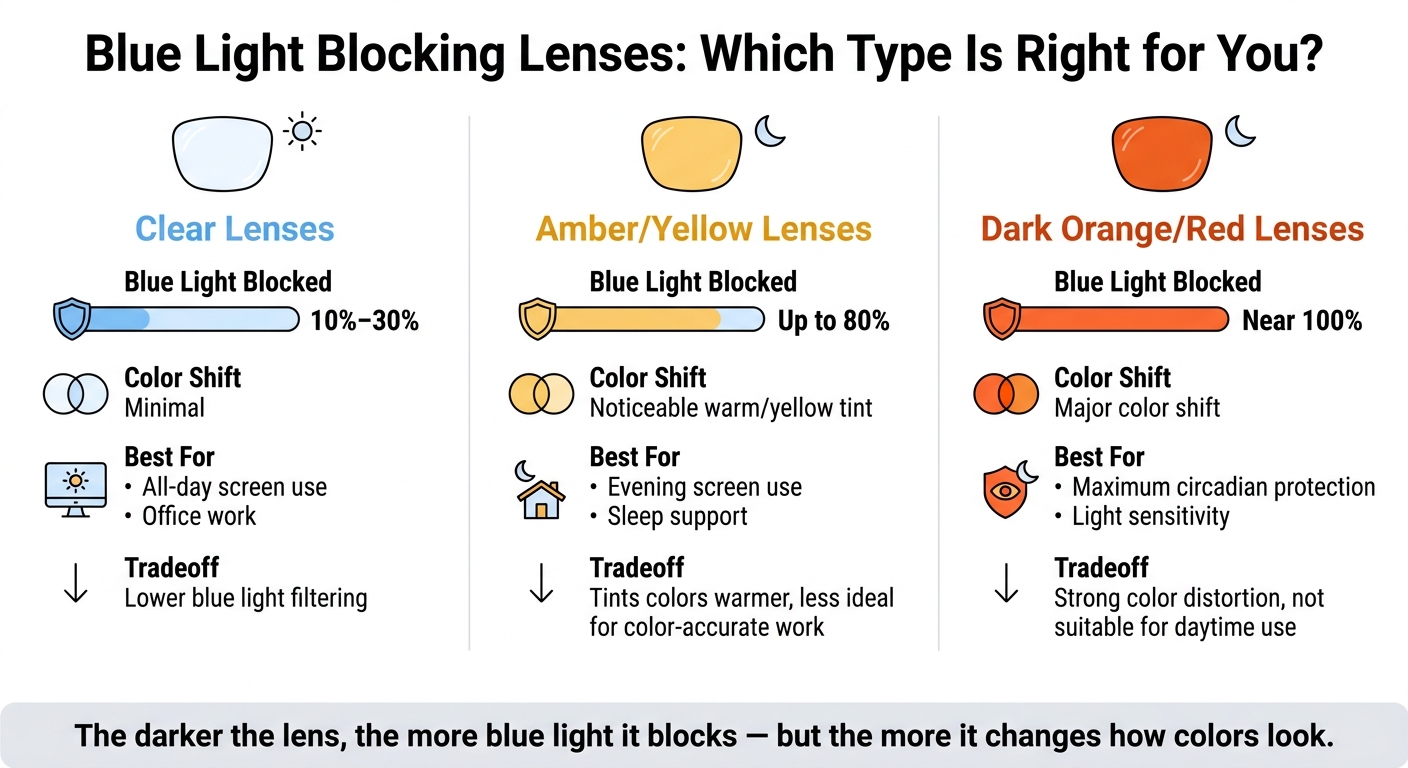
Blue Light Blocking Lenses: Clear vs. Amber vs. Dark Orange Compared
Reflective Coatings, Absorptive Filters, and Wavelength Ranges
If you decide to get blue light filtering, the next step is simple: figure out how much light the lens blocks and how much it changes color. That part matters more than many people think. Filter strength, color tint, and how long you wear the lenses all shape the effect you get.
Blue light blocking lenses cut down the amount of blue-violet light that reaches your eyes in two main ways: with a surface coating or with a filter built into the lens material.
Blue light falls roughly between 380 and 500 nanometers (nm). Many standard lenses focus on the narrower 400–450 nm band. Stronger filters reach farther across the blue range, but that usually comes with a more obvious color change.
Clear, Amber, and Dark Orange Lenses Compared
In general, tint and filter strength go hand in hand: the darker the lens, the more blue light it blocks.
| Lens Type | Blue Light Blocked | Color Shift | Typical Use |
|---|---|---|---|
| Clear | 10%–30% | Minimal | All-day screen use |
| Amber/Yellow | Up to 80% | Noticeable warm/yellow tint | Evening screen use, sleep support |
| Dark Orange/Red | Near 100% | Major color shift | Maximum circadian protection, light sensitivity |
Those tradeoffs show up fast in day-to-day use. Clear lenses tend to work better when you want less visual change. Amber and darker lenses block more blue light, but they can make colors look warmer, which may not be ideal for every task.
Blue Light Filtering in Prescription Glasses and Intraocular Lenses
Blue light filtering can be added to single-vision, bifocal, or progressive prescription lenses. It may come as a surface coating or as part of the lens material itself during manufacturing.
You may also run into computer-specific lenses made for screen distance. These sometimes include anti-fatigue support in the lower part of the lens.
Blue light-filtering intraocular lenses are also an option that may come up during cataract surgery planning.
Benefits, Limits, and How to Read Claims Carefully
What Research Says About Eye Strain, Sleep, and Visual Performance
Now that the lens types are clear, the next step is simple: do the claims hold up?
For eye strain and day-to-day screen use, the research doesn’t look very strong. A 2023 Cochrane review covering 17 randomized trials found that blue light filtering lenses probably do not reduce digital eye strain, contrast sensitivity, or visual performance compared with standard lenses.
Sleep is the one area where there may be some effect. Amber or darker lenses worn for 1–2 hours before bed may modestly help circadian timing, but the evidence is mixed.
| Claim | What Research Evaluated | Current Evidence Consensus | Practical Takeaway |
|---|---|---|---|
| Reduces eye strain | 17 randomized controlled trials (Cochrane 2023) | Probably makes no difference vs. standard lenses | Focus on the 20-20-20 rule and ergonomics |
| Improves sleep | Melatonin suppression and sleep onset studies | Mixed; may help if worn 1–2 hours before bed | Use Night Mode or f.lux in the evening |
| Protects retina | Lab exposure levels vs. real-world screen output | Screens emit far below harmful thresholds | Sunlight is a much larger source of blue light |
| Boosts visual performance | Contrast and clarity tests in clinical settings | No measurable improvement found | A correct prescription does more for clarity |
That table tells the story pretty well. A lot of the marketing around these lenses sounds bigger than what the studies show. If your eyes feel tired after hours at a screen, lens coatings may not be the thing doing the heavy lifting. Screen breaks, viewing distance, lighting, and the right prescription usually matter more.
Visual Tradeoffs: Color, Brightness, and Adaptation
There’s also a tradeoff people don’t always think about.
When a lens blocks more blue light, it also changes how things look. More filtration across the clear, amber, and dark orange categories means darker, warmer vision and less color accuracy. In plain English: the stronger the filter, the more the world can look slightly tinted.
That can be a problem for color-sensitive work and for driving, which is why high-filtration tints make more sense for evening use.
So the practical choice comes down to fit. Match the lens to how you use screens at night, how much tint you can live with, and whether color accuracy matters for your work.
How to Choose Blue Light Blocking Lenses in the United States
Key Specs to Check Before You Buy
Once you’ve looked at the evidence, the next step is simple: what should you check before buying?
Start with the lens specs. Check the stated blocking range and the percentage blocked at 450 nm. You want the exact number, not a vague claim. It also helps to know what kind of tint that filter creates, since even a light tint can change how the lens looks in daily use.
Then look at how the filter is made. Is it built into the lens material, or is it added as a surface coating? That detail can affect both price and wear over time. You should also check for full UV protection. And if you’ll be staring at screens for hours, an anti-reflective (AR) coating is worth having because it cuts glare and surface reflections that can add to eye fatigue.
For desk work, there’s one more thing to ask: is the prescription set for your monitor distance? That matters more than many people think, especially if you spend most of the day at one screen setup.
Once you know how strong a filter you want and how much tint you’re okay with, compare the price and what your plan may cover.
Cost, Insurance, and Prescription Considerations
After the specs, the final choice usually comes down to cost and prescription needs.
Blue-light coatings usually add $17 to $50. Premium blue-light glasses can run $100 to $300+. The good news is that blue light filtering can usually be added to single-vision, bifocal, or progressive lenses, so you may not need a separate pair of glasses.
In the United States, many vision insurance plans include a frame allowance of about $130 to $200. Coverage for coatings or tints can vary, so it’s smart to confirm that before you order. For qualifying cataract patients, Medicare Part B covers one pair of standard eyeglasses after surgery, subject to the current deductible.
| Lens Option | Typical Use | Impact on Vision | Common Extra Cost Factors | Questions to Ask During an Optical Consultation |
|---|---|---|---|---|
| Standard Clear Filter | All-day wear, general office work | Minimal; slight yellow residual tint | Anti-reflective (AR) coating quality | How much blue light does this block? |
| Amber/Orange Tint | Evening screen use, sleep prep | Significant color shift; dims brightness | High-index materials for thickness | Will this interfere with color-accurate work? |
| Computer Progressives | Dedicated desk/office environments | Wide intermediate zone; limited distance | Custom digital surfacing | Can you optimize these for my specific monitor distance? |
Conclusion: Matching the Right Lens to Your Eyes, Habits, and Goals
The clearest fit is often evening wear. Amber or darker lenses are commonly used for sleep prep and evening screen time. During the day, eye strain is often tied just as much to ergonomics and screen habits as to the lens itself.
The right lens usually comes down to three things:
- Your prescription needs
- When you use screens
- How much tint you can handle without it getting in the way of your work
Those are personal choices, and a product page can’t sort them out for you.
A full eye exam can help separate blue-light concerns from plain old prescription issues. About 66% of Americans deal with digital eye strain symptoms, and some of those symptoms may come from an outdated prescription or uncorrected astigmatism, not blue light by itself. Eye Center of Northern Colorado offers comprehensive eye exams and optical guidance to help match blue-light filters or computer-specific prescriptions to your needs.
FAQs
Do I actually need blue light glasses?
Not usually. Current clinical evidence, including a 2023 Cochrane review, suggests blue light glasses aren’t needed for most people and may provide little to no meaningful help with digital eye strain or sleep quality.
At the Eye Center of Northern Colorado, experts suggest putting your energy into habits backed by evidence instead. That means:
- Setting up your screen with good ergonomics
- Following the 20-20-20 rule
- Blinking enough throughout the day
- Getting regular eye exams
Which lens color is best for sleep?
Research on the best lens color is still limited. But one thing is clear: cutting down evening blue light matters if you want to support your sleep cycle.
Here’s why. Blue light can suppress melatonin and tell your brain it’s still daytime. That makes it harder for your body to wind down when bedtime rolls around.
To help improve sleep, Eye Center of Northern Colorado recommends blue light filtering, especially before bed. They also suggest a digital sunset, device night modes, and warmer amber- or yellow-toned lighting at home.
What matters more than blue light filtering?
More important than blue light filtering is dealing with the main drivers of digital eye strain. Most screen-related discomfort comes from Computer Vision Syndrome and the way we use our devices, not just the light coming off the screen.
To ease symptoms, focus on better screen ergonomics. Keep your screen about 20 to 28 inches away, cut glare where you can, follow the 20-20-20 rule, and blink more often.
That last point sounds almost too simple, but it matters. When people stare at screens, they often blink less without even noticing. And that can leave eyes feeling dry, tired, and irritated fast.