Struggling to read menus or text messages? That’s likely presbyopia – a common condition as you age. Finding the right reading glasses strength, or diopter, can make a big difference in reducing eye strain and improving clarity.
Here’s what you need to know:
- Diopters measure magnification power: Over-the-counter glasses range from +1.00 to +3.75.
- Age-based guidelines: Start with +1.00 to +1.50 in your early 40s, increasing gradually with age.
- Test at home: Use a diopter chart to estimate your strength.
- Professional exams matter: If you need stronger than +3.25 or have ongoing issues, consult an optometrist.
The goal is clear, comfortable vision – whether you’re reading a book or working on a screen. Start with these tips, and adjust as needed for your unique eyesight.
Understanding Reading Glasses Strength and Diopter Measurements
What Diopters Measure
Diopters are the units used to measure the magnification power of a lens. They indicate how much assistance your eyes need for clear close-up vision. For instance, when you see reading glasses marked +1.50 or +2.25, that number reflects the diopter strength.
A higher diopter means stronger magnification. For example, +1.00 diopters offer mild magnification, often suitable for those with early presbyopia, while +3.00 diopters provide stronger magnification, typically for more advanced cases. This standardized system helps ensure consistency across different lenses.
Let’s take a closer look at the common strength ranges you’ll find.
Common Strength Ranges
Over-the-counter reading glasses usually come in 0.25 diopter increments, starting at +1.00 and going up to +3.25 or +3.75. These options cater to varying degrees of presbyopia. If you’re trying out different strengths and find that two adjacent options (like +1.50 and +1.75) both seem to work, it’s often better to go with the lower strength. This can reduce eye strain during extended periods of reading.
If you find you need a strength higher than +3.25, it’s a good idea to book a comprehensive eye exam. Higher prescriptions often require a professional evaluation to ensure accuracy and to rule out any other underlying vision concerns.
How to Find Your Correct Reading Glasses Strength
Get a Professional Eye Exam
The most accurate way to determine your reading glasses strength is by scheduling a comprehensive eye exam with an optometrist or ophthalmologist. Clinics like Eye Center of Northern Colorado provide in-depth evaluations that go far beyond simple vision screenings. During the exam, the doctor uses a phoropter to identify the lens that offers the clearest reading vision. Additional tests, such as retinoscopy and visual acuity assessments, may also be performed.
For those with presbyopia, the doctor calculates the "ADD" power in your prescription. This number represents the extra magnification needed for close-up activities. Adults between 40 and 64 years old should aim for a comprehensive eye exam every two years – or annually if there’s a higher risk of eye conditions. Before your appointment, prepare to discuss when your vision issues began, any medications you’re taking, and activities like computer work or hobbies that might affect your eyesight.
If you need a quick idea of your reading strength before seeing a professional, you can try using a diopter chart at home.
Test Your Strength at Home with a Diopter Chart
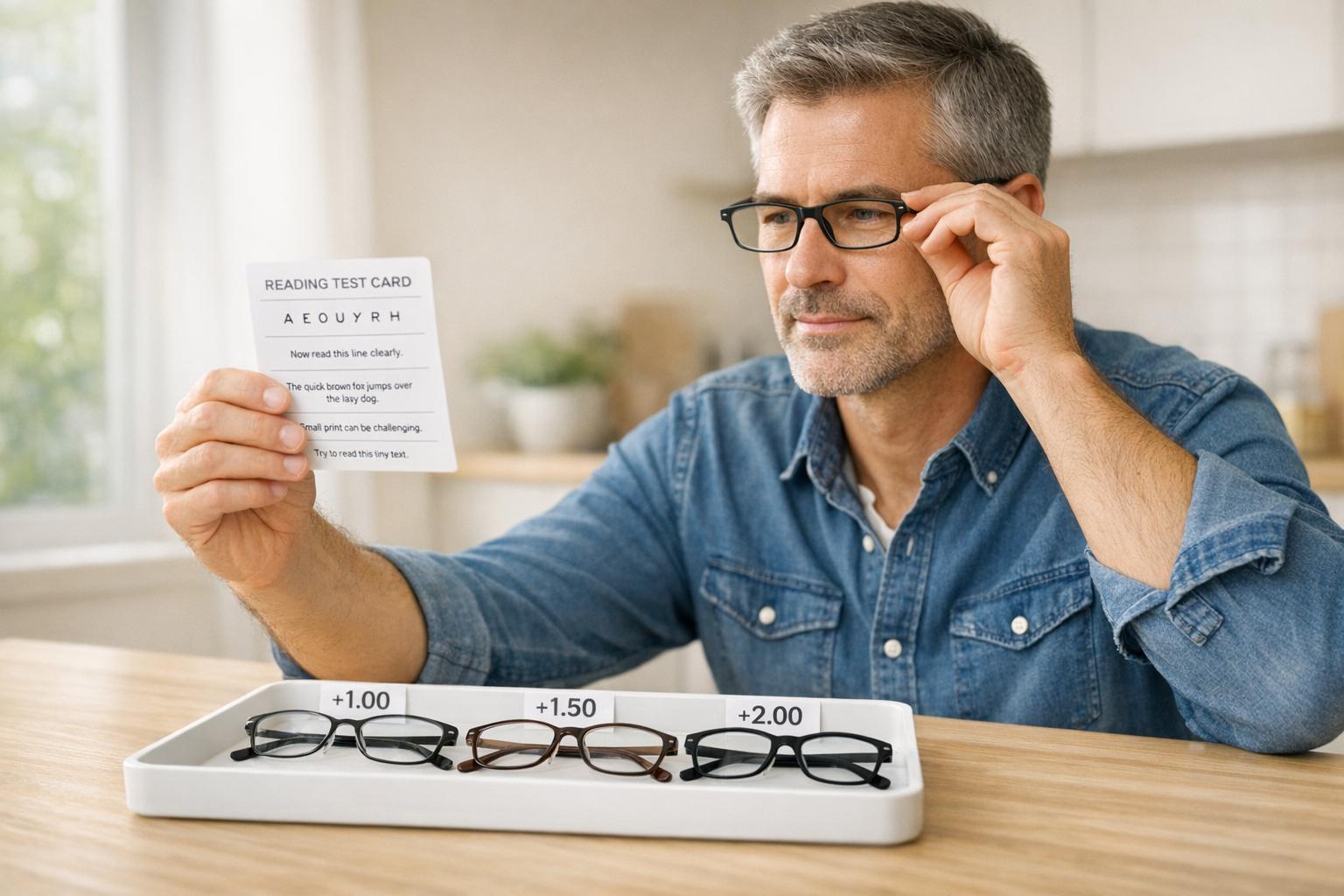
A diopter chart can give you a rough estimate of your reading glasses strength from the comfort of your home. This tool includes rows of text in varying sizes, with each line corresponding to a specific diopter strength. To use it correctly, print the chart at 100% scale and double-check its dimensions with a ruler.
Hold the chart 14 inches from your eyes, without wearing glasses or contacts. The smallest line you can read clearly indicates your approximate strength. For instance, if you can read the third line without difficulty, you might need +1.50 diopters. Be sure to test each eye separately, as they might require different strengths. Keep in mind, though, that this method only provides an estimate and is no substitute for a professional eye exam.
Age-Based Strength Guidelines
While everyone’s vision is unique, age can serve as a general guide for selecting reading glasses strength. Presbyopia typically starts around age 40 and progresses through the mid-60s. Here’s a breakdown of common starting strengths by age:
- Ages 40–45: +1.00 to +1.50 diopters
- Ages 45–50: +1.50 to +2.00 diopters
- Ages 50–55: +2.00 to +2.50 diopters
- Ages 55–60: +2.50 to +3.00 diopters
- Ages 60 and older: +3.00 to +3.50 diopters
However, age alone shouldn’t dictate your lens strength. The distance at which you typically read or work is just as important. Standard reading glasses are designed for a distance of about 14 inches, but if you’re working with screens or objects further away – like 18–28 inches – you’ll likely need a slightly lower strength. A general rule is to reduce the power by 0.25 diopters for every 6 inches beyond 28 inches.
What strength reading glasses do I need?
sbb-itb-5ef6ec9
Reading Glasses Strength Levels and When to Use Them
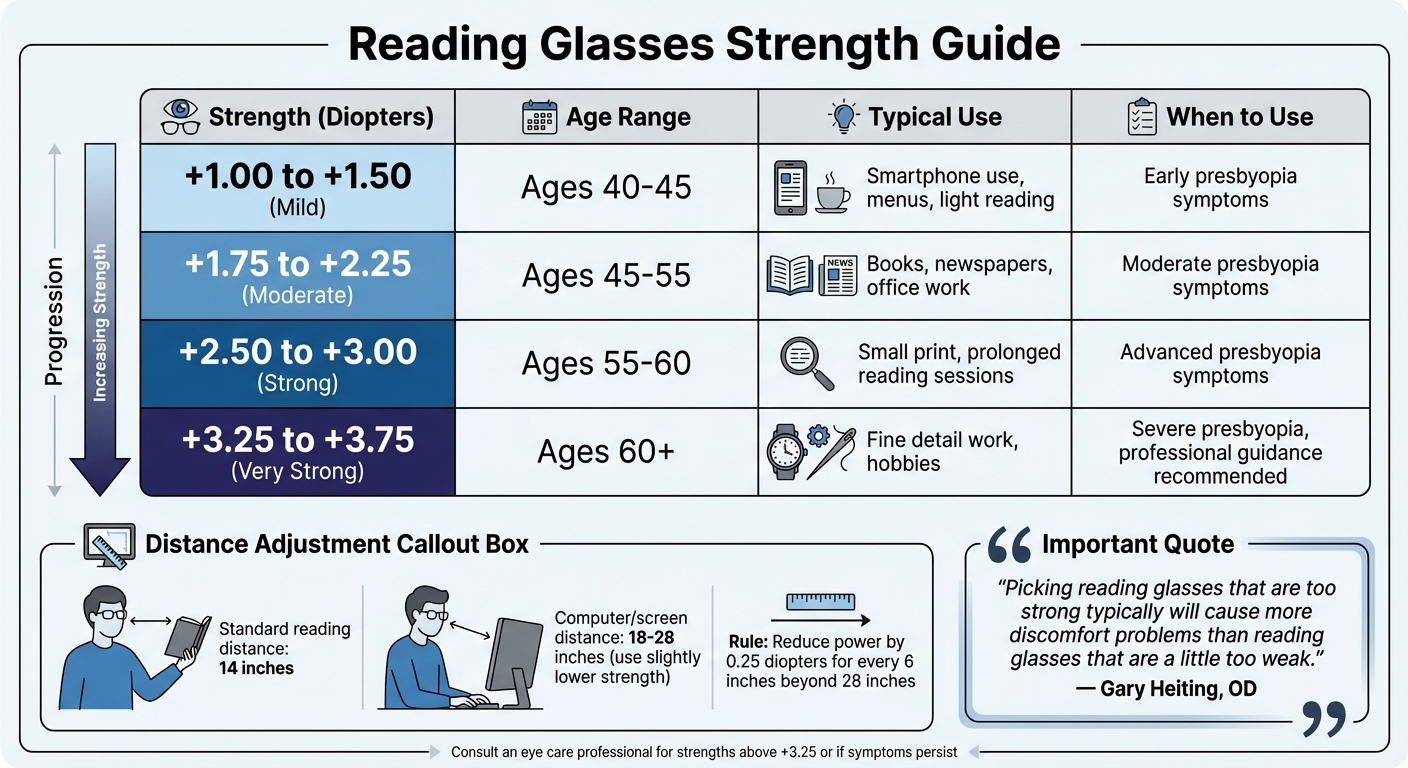
Reading Glasses Strength Guide by Age and Use
Choosing the right reading glasses strength depends on your home test results and age-based guidelines. Understanding diopter measurements can help you pinpoint the best option for your needs.
Most over-the-counter reading glasses range from +0.75 to +3.00 diopters, though some go as high as +3.75 diopters. Here’s a breakdown of common strength levels and their uses:
- Mild Strength (+1.00 to +1.50 diopters): Ideal for early presbyopia, often experienced in your early 40s. These work well for reading menus or checking text messages.
- Moderate Strength (+1.75 to +2.25 diopters): Suited for those in their mid-40s to mid-50s who notice a decline in near vision. Use these for books, newspapers, or office tasks.
- Strong Strength (+2.50 to +3.00 diopters): Designed for advanced presbyopia, typically affecting people aged 55 and older. These are perfect for small print or extended reading sessions.
"Picking reading glasses that are too strong typically will cause more discomfort problems than reading glasses that are a little too weak."
- Gary Heiting, OD
Distance matters: For screens positioned about 20 inches away, slightly lower power is recommended compared to reading a book held at 14 inches. If you’re working on something very close, like threading a needle, consider increasing your diopter strength by +0.25 to +0.50 over your usual reading glasses. You might also benefit from having different pairs for specific tasks.
Strength Levels Comparison Table
| Strength (Diopters) | Typical Use | When to Use |
|---|---|---|
| +1.00 to +1.50 | Smartphone use, menus, light reading | Early presbyopia symptoms |
| +1.75 to +2.25 | Books, newspapers, office work | Moderate presbyopia symptoms |
| +2.50 to +3.00 | Small print, prolonged reading sessions | Advanced presbyopia symptoms |
| +3.25 to +3.75 | Fine detail work, hobbies | Severe presbyopia, professional guidance recommended |
If you’re unsure or your vision needs don’t align perfectly with these general categories, consult a professional. The Eye Center of Northern Colorado offers personalized advice and thorough evaluations to ensure your vision care is tailored to you.
Signs Your Reading Glasses Strength Needs Adjustment
Your vision can change over time, so it’s important to keep an eye on how well your reading glasses are working for you. Recognizing early signs of an incorrect prescription can help you avoid discomfort and ensure your glasses are doing their job.
Symptoms of Incorrect Strength
If your glasses are the wrong strength, your eyes might let you know through a variety of symptoms:
- Eye strain: Feeling fatigue or a slight pulling sensation in your eyes by the end of the day could mean your prescription isn’t quite right. This discomfort, also known as asthenopia, is a common red flag.
- Headaches: Persistent headaches, especially around your forehead or temples after reading or close-up work, can be a sign of eyestrain caused by an incorrect prescription. As one source explains, “Headaches are another common symptom of wearing the wrong eyewear prescription. This is caused by eyestrain which results from your eyes being overworked”.
- Blurred or distorted close-up vision: If you find yourself squinting, holding reading material at odd distances, or tilting your head to see clearly, your glasses may need an update. In some cases, you might even experience double vision (diplopia) if the lenses are improperly powered or unbalanced.
- Dizziness, vertigo, or nausea: An overly strong prescription can mess with your depth perception, causing these unsettling symptoms. Straining your neck and shoulders to find a comfortable reading position can also be a clue.
- Blurry vision in one eye: Try the "One Eye Test." With your glasses on, cover one eye and look straight ahead. If the uncovered eye sees blurry, your prescription might be off.
If these issues persist, even after giving yourself time to adjust to new glasses, it may be time to consult a professional.
When to See an Eye Care Professional
If you’ve tried making adjustments at home but the symptoms don’t improve, it’s time to seek professional help. Allow yourself about two weeks to a month to adapt to new glasses, especially if you’ve switched to bifocals or progressives. However, if problems persist beyond that, it’s a good idea to schedule an appointment.
Some situations require immediate attention – such as sudden changes in vision, eye pain, double vision, or seeing flashes of light or halos. These could indicate more serious issues.
The American Academy of Ophthalmology suggests a baseline eye exam at age 40, as this is when presbyopia (age-related difficulty focusing on close objects) often starts. After that:
- Ages 55–64: Get your eyes checked every one to three years.
- Ages 65 and older: Schedule an exam every one to two years.
Even for younger individuals, it’s a good idea to reassess your reading glasses strength every 12 to 24 months, as vision naturally changes over time.
If over-the-counter reading glasses don’t seem to work or if you need different strengths for each eye, a professional prescription might be the solution. The Eye Center of Northern Colorado, for instance, offers customized prescriptions and specialized options like progressive lenses, which can help you see clearly at a variety of distances – from reading a book up close to working on a computer screen farther away. Professional prescriptions can also address astigmatism and other issues that generic readers can’t. Regular updates ensure your glasses stay effective and comfortable.
Conclusion
Determining the right strength for your reading glasses doesn’t have to be complicated. Diopters, which measure lens power, typically range from +0.75D to +3.00D for most over-the-counter options. You can use a diopter chart at home to get a good estimate of your needs. If you find yourself stuck between two strengths, it’s usually better to go with the lower one.
That said, nothing beats a professional eye exam. An optometrist can identify vision issues like astigmatism, which generic readers often overlook. Licensed Optician Steve Mower highlights this:
"Possible factors like astigmatism for example, when corrected, can improve your vision dramatically. You won’t know until you get an eye exam".
FAQs
How do I know if my reading glasses are the right strength?
If your reading glasses aren’t the right strength – whether they’re too strong or too weak – you might notice symptoms like blurry vision, eye strain, headaches, or even dizziness. Struggling to focus or having trouble with depth perception are also common signs that your lenses may not be doing their job.
The best way to address this? Schedule a comprehensive eye exam with an eye care professional. For example, the Eye Center of Northern Colorado provides tailored optical services and a variety of eyeglasses to match your specific vision needs.
Why should I see an eye doctor if I need reading glasses stronger than +3.25?
If your vision requires reading glasses stronger than +3.25, it’s crucial to consult an eye doctor. They can provide a precise prescription tailored to your unique needs, ensuring your vision is properly corrected. A professional exam can also uncover underlying eye conditions, like astigmatism or presbyopia, that generic, over-the-counter glasses simply can’t address.
Stronger prescriptions might also signal more complex vision problems. An expert evaluation helps safeguard your eye health and reduces the risk of potential complications down the road.
How often should I update the strength of my reading glasses as I get older?
As we get older, it’s common for near vision to shift, which means it’s a good idea to check the strength of your reading glasses regularly. Experts suggest doing this every 1–2 years, or sooner if you notice signs like needing to hold reading material at arm’s length, frequent eye strain, or headaches while reading.
Booking regular eye exams with a reliable provider, like the Eye Center of Northern Colorado, can help keep your prescription accurate and ensure your vision stays sharp and comfortable.