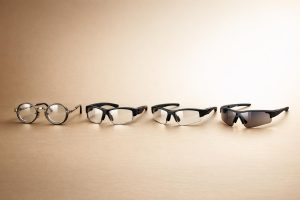
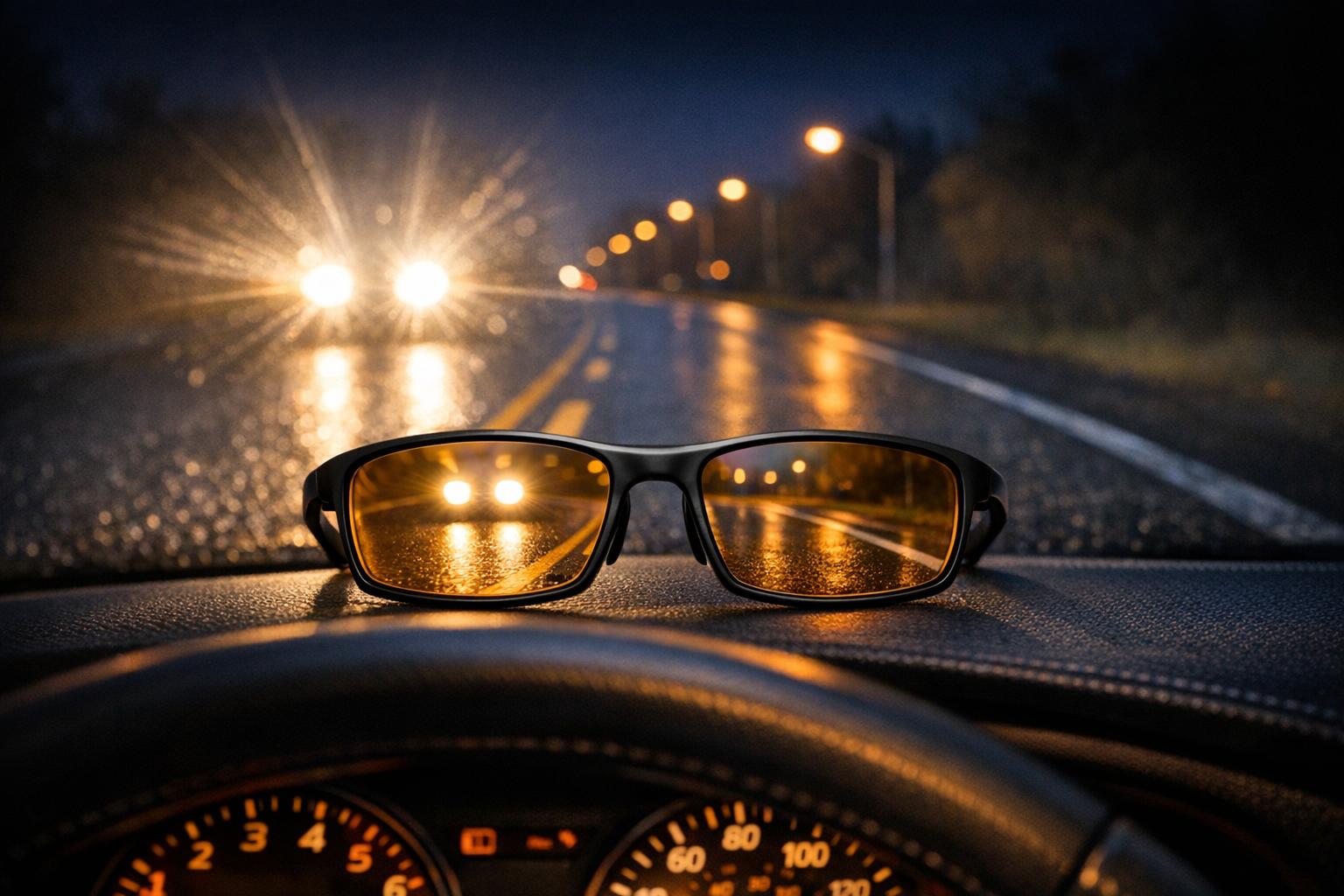
Driving at night can be challenging due to reduced visibility and glare from modern headlights. Night driving glasses are designed to address these issues by reducing glare, improving contrast, and enhancing overall clarity. Here’s what you need to know:
- Anti-Reflective (AR) Coatings: Reduce glare by up to 90%, improve light transmission (up to 99.5%), and provide sharper vision without dimming.
- Yellow or Amber Tints: Filter blue light to improve contrast but may slightly reduce overall brightness.
- Polarized Lenses: Block horizontal glare from surfaces like wet roads but can dim visibility in very dark conditions.
- Wraparound Frames: Protect peripheral vision from side glare while offering a wider field of view.
- Durable and Lightweight Designs: Materials like TR-90 thermoplastic and polycarbonate ensure comfort and long-lasting use.
- Prescription-Compatible Options: Combine vision correction with anti-glare features for tailored performance.
Quick Tip: Older drivers, who are more sensitive to glare, may find AR coatings especially helpful. Pairing these with clean windshields and properly maintained headlights can further improve nighttime driving safety.
Whether you’re looking for anti-glare coatings, tinted lenses, or prescription options, the right pair of night driving glasses can make a noticeable difference in visibility and comfort.
Night Driving Glasses Comparison: Features, Performance & Best Conditions
Do NIGHT VISION Glasses Work? – Night Driving Glasses Review
sbb-itb-5ef6ec9
Key Features of Night Driving Glasses
Night driving glasses are designed to reduce glare and improve visibility in low-light conditions. For instance, high-quality anti-reflective (AR) coatings allow up to 99.5% of light to pass through, compared to standard lenses that only let in 92%. This makes a big difference since our eyes receive 80% less light in dim environments.
Lens tints also play a role by working alongside AR coatings to reduce distracting light effects. Yellow or amber tints, for example, filter out high-energy blue light, which helps cut down on starbursts and improves contrast. However, studies show that these tints don’t provide a measurable improvement in spotting pedestrians compared to clear lenses. This underscores the importance of combining tints with AR coatings to prevent internal reflections and maximize performance.
Frame Design and Durability
The frame design is just as critical, especially for long drives. Materials like TR-90 thermoplastic are popular because they’re flexible, durable, and lightweight – ideal for extended wear. Adjustable nose pads and spring hinges add to the comfort, ensuring a snug fit, while wraparound styles block glare from side angles.
Durability is another key factor. Polycarbonate lenses offer excellent impact resistance, and rubberized coatings help keep the glasses from slipping. For non-prescription models, prices typically range from $7 to $70, with the sweet spot for quality falling between $17 and $36.
These features make night driving glasses a practical choice for anyone looking to improve their nighttime driving experience.
1. Anti-Glare Coating Glasses
Anti-Glare Effectiveness
Anti-glare coatings play a key role in reducing those annoying visual distractions you often encounter during night driving. These coatings, also known as AR coatings, significantly improve light transmission compared to standard lenses. By allowing visible light to reach your eyes directly, they cut down on reflections that can create ghost images or distortions. This makes it easier to stay focused on the road.
One of their standout benefits is minimizing the harsh glare from LED and HID headlights, which can feel blinding at times. This allows drivers to better concentrate on lane markings and detect obstacles ahead. By eliminating internal reflections, AR-coated lenses provide sharper vision, helping drivers spot road edges and potential dangers more effectively.
According to WebEyeCare, "AR-coated lenses allow more light to pass through while minimizing reflections, resulting in sharper vision at night".
This feature isn’t just a convenience – it’s a crucial addition for safer night driving.
Durability and Safety Features
AR coatings are designed to last. While standard versions typically remain effective for one to two years, premium coatings can provide up to four years of durability. These coatings are made up of 27 microscopic layers that are fused into the lens material itself, making them far more resistant to scratches and wear compared to older versions.
Premium AR coatings often come with hydrophobic and oleophobic layers, which repel water and oils, making cleaning a breeze and offering long-term protection. However, proper care is essential to maintain their effectiveness. Always rinse your lenses with water before wiping to avoid scratches, and avoid exposing them to extreme heat, which can lead to crazing – a condition where the coating and lens expand at different rates.
Licensed optician Ray LeBlanc explains, "Most AR coatings are warrantied for 2 years and the coatings are usually good for at least 3 years with the premium coatings lasting 4 years".
For those who wear prescription glasses, AR coatings are especially helpful in reducing glare caused by the lenses themselves. When paired with optimized tints and durable frames, these coatings create a well-rounded solution for safer and more comfortable night driving.
2. Yellow or Amber Tinted Glasses
Lens Tint for Contrast Enhancement
Yellow and amber lenses are designed to filter out high-energy blue light, particularly from LED and Xenon headlights. This helps reduce distracting halo and starburst effects. By cutting down on blue light, these lenses improve contrast, making road signs, lane markers, and potential hazards stand out more clearly. When combined with anti-reflective (AR) coatings, the contrast enhancement is even greater, while also addressing any glare issues.
However, it’s important to note that tinted lenses reduce overall brightness. In very dark or poorly lit environments, this can be a drawback. While some drivers find yellow lenses helpful, a Harvard study revealed no significant improvement in detecting pedestrians at night.
"Yellow lenses are commonly marketed as the best option for night driving, but their effectiveness depends on the situation. While they can enhance contrast and reduce glare in certain low-light conditions, they also slightly reduce overall brightness." – WebEyeCare
These lenses work well alongside other anti-glare technologies and pave the way for advancements like polarized night driving glasses.
Durability and Safety Features
For durability and safety, polycarbonate lenses are a solid choice. They’re lightweight and offer strong resistance to impact from road debris. If you opt for yellow tints, always pair them with an AR coating. Without it, the tint can actually increase glare due to internal reflections.
Before making yellow-tinted glasses a regular part of your night driving routine, try them out in various lighting conditions. And don’t forget – keeping your glasses and windshield clean is just as important for clear vision.
3. Polarized Night Driving Glasses
Polarized night driving glasses take the benefits of AR coatings and tinted lenses a step further, offering enhanced glare reduction and improved contrast for nighttime driving.
Anti-Glare Effectiveness
Polarized lenses use a chemical filter to block horizontal light waves, which are the primary cause of glare from wet roads and reflective surfaces. They also help reduce the intense brightness of modern LED and HID headlights, softening the "white flash" effect that can temporarily blind drivers. However, this glare reduction comes with a trade-off: it decreases overall light transmission. In very dark areas with little to no street lighting, this dimming effect can make it harder to see unlit objects or pedestrians. To ensure they work for your needs, test polarized glasses in various settings, from brightly lit city streets to dimly lit rural roads.
Another factor to consider is how polarized lenses interact with digital displays. They can distort or even completely black out screens on dashboards, GPS devices, or smartphones. Before hitting the road, check how your vehicle’s instrument cluster looks through the lenses.
Lens Tint for Contrast Enhancement
When paired with yellow or amber tints, polarized lenses become even more effective by filtering out high-energy visible (HEV) blue light from modern headlights. This combination improves contrast, making lane markings, road signs, and potential hazards stand out against dark surroundings. This can be particularly helpful for drivers with astigmatism, who often experience reduced "starburst" effects with polarized yellow lenses. Adding AR coatings to the mix enhances contrast further by minimizing internal reflections, allowing up to 99.5% of usable light to pass through the lenses.
"Polarized lenses can reduce the glare of oncoming vehicles. However, if the tint of the glasses is too heavy, polarized glasses can hurt your ability to drive at night by too heavily decreasing incoming light." – Automoblog Research Team
Prices for polarized night driving glasses range widely, from affordable options around $7 to high-end models costing up to $259. Beyond lens technology, the design of the frames also plays a key role in improving safety and comfort.
Frame Design for Comfort and Coverage
A well-designed frame not only adds comfort but also enhances the effectiveness of glare protection. Wraparound frames are particularly useful, as they block side-angle glare from streetlights or passing vehicles while providing a wide field of vision to help you spot hazards in your periphery. Lightweight materials like TR-90 thermoplastic or metal ensure comfort during long drives, while adjustable nose pads and flexible temples allow for a customized fit that prevents slipping or discomfort.
For those who wear prescription glasses, "fit-over" designs can sit comfortably on top of corrective lenses. Additionally, rubber-coated nosepieces and temples keep the glasses securely in place, making them ideal for extended use during long trips.
4. Contrast-Enhancing Glasses
Contrast-enhancing glasses take night driving eyewear a step further by focusing on reducing distractions while improving the clarity of your view. These glasses are designed to filter out high-energy visible (HEV) blue light from LED and HID headlights, making lane markings, road signs, and potential hazards appear more distinct. Unlike options that increase brightness, these glasses sharpen your vision without overexposing your eyes.
Lens Tint for Contrast Enhancement
Yellow tints are commonly used for enhancing contrast, as they reduce distractions without overly darkening your vision. Amber tints, on the other hand, are better suited for challenging conditions like fog or heavy rain. However, there’s some debate about their effectiveness. Research conducted by Harvard’s Schepens Eye Research Institute revealed that drivers using yellow-tinted glasses took up to 1.5 seconds longer to spot pedestrians compared to those who didn’t wear them. As noted in their findings:
"Our data suggest that wearing yellow-lens glasses when driving at night does not improve performance. Particularly in the most critical task: detection of pedestrians."
Anti-Glare Effectiveness
The true potential of contrast-enhancing glasses comes into play when paired with high-quality anti-reflective (AR) coatings. While the tint filters out disruptive blue light, AR coatings work to eliminate internal and external reflections, reducing distracting "ghost images" around lights. This combination allows up to 99.5% of usable light to reach your eyes, compared to just 92% with standard uncoated lenses. Instead of simply brightening your surroundings, these glasses refine the clarity of your vision by eliminating unwanted light interference.
Durability and Safety Features
For long-term use, opt for scratch-resistant, hard-coated lenses to maintain clear vision. High-quality AR coatings can cut glare by as much as 78%, though they require proper care to withstand daily wear. Polycarbonate lenses are another excellent choice, offering lightweight comfort and strong impact resistance to shield your eyes from road debris. Together, these features ensure both clarity and durability for safer driving.
5. Wraparound Frame Glasses
Once you’ve considered lens coatings and tints, the next step in enhancing night driving safety is the frame design. Wraparound frames are designed to curve around your face, shielding your peripheral vision from light sources in adjacent lanes or behind you. This design works hand-in-hand with anti-glare and tint technologies to offer better protection for your eyes.
As Trent Childress, Senior Auto Editor at The Buyer’s Report, puts it:
"Because the frame doesn’t wrap around the face like newer designs, peripheral visibility isn’t as protected. That means glare from cars beside or behind you can still hit your eyes directly."
Frame Design for Comfort and Coverage
The curved design of wraparound frames not only protects against glare but also provides a broader field of view. This reduces the need to constantly turn your head to check blind spots. Take the DriveBright Night Driving Glasses, for example. Priced at $35.99, they combine a wide field of vision with a snug fit. Another option is the Xiyalai Vipers, available for about $26. These glasses incorporate sports-inspired features, such as rubberized grips on the nosepiece and temple tips, ensuring they stay securely in place even during long drives.
Durability and Safety Features
Durability is another key consideration when choosing night driving glasses. Features like scratch-resistant and fog-resistant coatings help maintain clear lenses over time. The DriveBright model, for instance, boasts a 4.8/5 durability rating. For a more budget-friendly choice, the LVIOE Wrap Around Glasses, priced at approximately $16.99, have garnered 899 Amazon reviews with an average rating of 4.3/5. Many users appreciate how the wraparound design minimizes glare. Lightweight materials and flexible temples also enhance comfort, ensuring the glasses stay secure without causing discomfort during extended use.
6. Lightweight and Flexible Frame Glasses
When choosing glasses for night driving, frame weight and flexibility play a big role in comfort. Materials like TR-90 thermoplastic or polycarbonate are excellent choices because they reduce pressure on your nose and ears, even during extended drives.
"Since night-driving glasses are often worn for extended periods, it’s important to choose lightweight and comfortable frames. Adjustable nose pads and flexible temples can enhance the fit to prevent discomfort during long drives".
Lightweight frames not only improve comfort but also ensure a snug, secure fit, which is crucial for safe driving.
Frame Design for Comfort and Coverage
Flexible temples are particularly helpful, as they adapt to different head shapes without causing irritation. There are options for every budget: BLUEMOKY Reading Glasses (around $14) use TR-90 thermoplastic for a comfortable, flexible fit, Optix 55 Polarized Glasses (about $17) sit lightly on the nose, and Aisweet Night Driving Glasses combine metal frames with silicone components for just $7.
Another key consideration is maintaining clear peripheral vision. Thick frames can create blind spots, obscuring pedestrians or merging traffic. Lightweight designs help prevent fatigue, allowing you to stay focused during long drives in low-light conditions.
Durability and Safety Features
In addition to being lightweight, durability is essential. Features like spring hinges and flexible materials ensure the glasses can handle everyday wear and tear, including accidental drops or being stored in your car. Rubberized or silicone coatings on the nosepiece and stems provide extra grip, keeping the glasses securely in place even during sudden movements.
TR-90 thermoplastic stands out for its durability and resistance to heat, making it a solid choice for regular use. Metal frames with spring hinges offer a more classic look while still providing excellent adjustability and resilience. Both options are built to last, ensuring you get a comfortable and reliable fit every time.
7. Prescription-Compatible Night Glasses
Prescription-compatible night glasses are a must-have for safe nighttime driving if you have refractive errors. Conditions like "night myopia" become more noticeable in low-light settings, making tailored prescriptions essential to sharpen distance vision. These glasses combine the advantages of non-prescription night glasses with the added benefit of correcting vision, enhancing overall safety.
Anti-glare effectiveness
Prescription glasses designed for night driving often incorporate advanced anti-glare technology. Glare from reflective lens surfaces can significantly hinder vision, but anti-reflective (AR) coatings address this issue. AR coatings are particularly important for prescription lenses, as they reduce reflections on both the front and back surfaces. This ensures maximum light transmission – up to 99.5% – which is critical for spotting potential hazards like pedestrians in low-light conditions. Keeping lenses clean is equally important, as smudges or dirt can scatter light and amplify glare.
Lens tint for contrast enhancement
For night driving, prescription glasses with clear lenses and AR coatings are ideal. Clear lenses allow nearly 100% of visible light to reach your eyes, unlike tinted lenses, which reduce light intake. Studies indicate that tinted lenses, especially darker ones like amber or copper, can dim the overall brightness, making it harder to see in already low-light environments. Opting for clear lenses with AR coatings ensures optimal visibility and contrast.
Frame design for comfort and coverage
Comfort and safety are key considerations for prescription-compatible night glasses. You can choose between prescription-specific frames or "fit-over" designs that work with your existing glasses. For instance, DriveBright Night Driving Glasses ($35.99) offer a fit-over style and are rated 4.8/5, with optometrists recommending their "GlareCut" technology for reducing glare without compromising field-of-view clarity. Another option, BLUPOND Night Driving Glasses ($48.00), features lightweight metal frames but has a slightly lower 4.3/5 rating due to narrow lenses that limit peripheral vision. Wraparound frames are often preferred as they block glare from the sides, providing better peripheral coverage. For long drives, look for adjustable nose pads and lightweight materials like acetate or thin metal to enhance comfort.
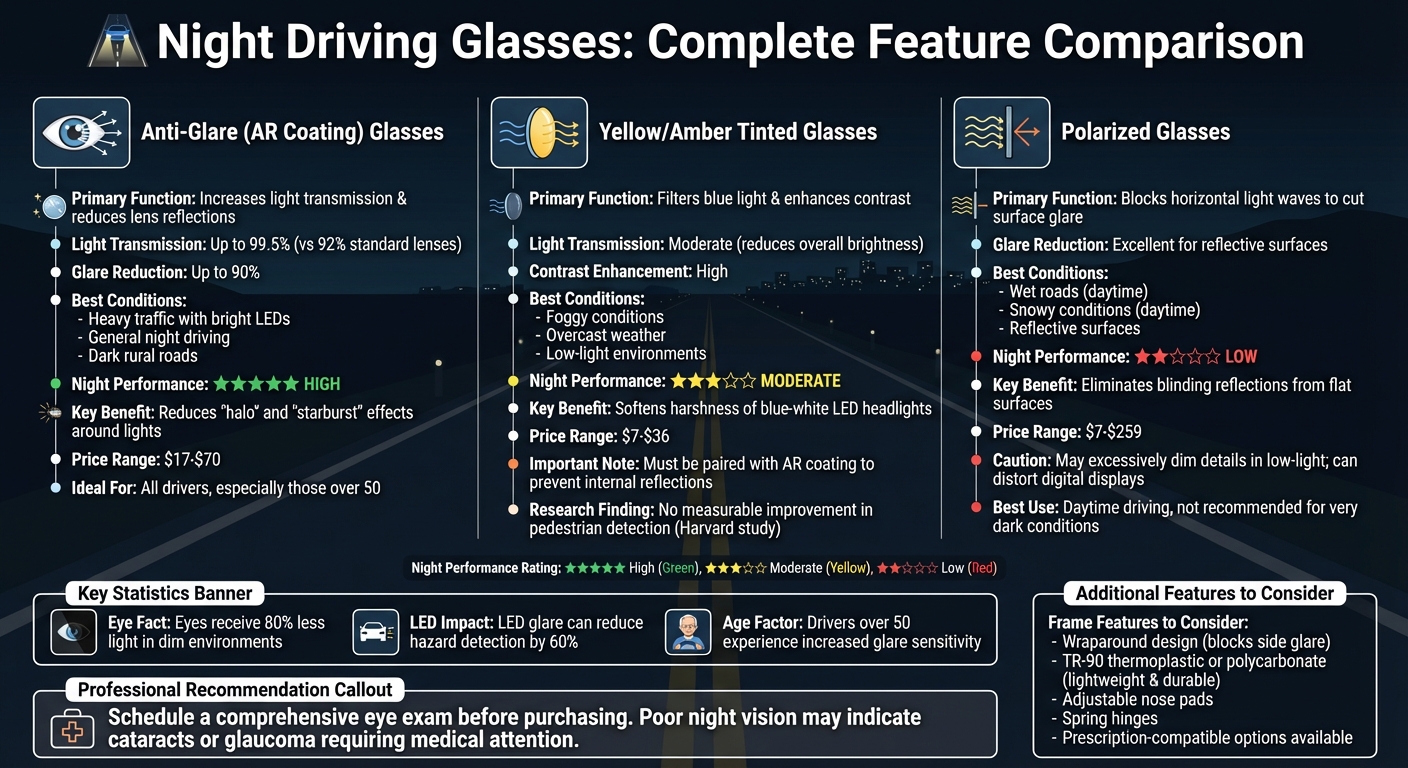
Feature Comparison Table
Here’s a handy table summarizing the major lens types to help you quickly compare features and decide which is best for your driving needs. It highlights the key differences between popular lens technologies, making it easier to match their benefits to your driving environment.
| Glass Type | Primary Function | Best Driving Conditions | Night Performance | Key Benefit |
|---|---|---|---|---|
| Anti-Glare (AR Coating) | Increases light transmission; reduces lens reflections | General night driving; heavy traffic with bright LEDs | High; provides the clearest vision without dimming | Reduces "halo" and "starburst" effects around lights |
| Yellow-Tinted Glasses | Filters blue light; enhances contrast | Low-light, foggy, or overcast conditions | Moderate; improves contrast but reduces overall brightness | Softens the harshness of blue-white LED headlights |
| Polarized Glasses | Blocks horizontal light waves to cut surface glare | Daytime driving; wet or snowy roads | Low; may excessively dim visible details in low-light conditions | Eliminates blinding reflections from flat surfaces |
This comparison highlights the importance of choosing the right lens features to improve safety and visibility during night driving.
AR-coated lenses are particularly effective for nighttime use, as they maximize light transmission and reduce glare, making them ideal for dark rural roads or urban areas with bright LED headlights. Yellow-tinted glasses shine in foggy or overcast conditions by boosting contrast, though they slightly dim your overall view. Meanwhile, polarized lenses excel during daylight for cutting glare on wet or snowy roads but are less effective at night due to their tendency to darken details.
For drivers over 50, who often face increased glare sensitivity, AR-coated lenses can be a game-changer. They significantly reduce glare, making nighttime driving smoother and safer.
"Glasses with anti-reflective coatings can reduce up to 90% of the glare, offering a smoother and safer driving experience." – Eye Level Optical
Additionally, wraparound frames and lightweight materials like titanium or TR-90 help block side glare and ensure comfort during long drives. If you wear prescription glasses, fit-over designs can add anti-glare benefits without requiring a completely new pair. Together, these features create a tailored solution for safer and clearer night driving.
Conclusion
Selecting the right night driving glasses is more than just a convenience – it’s about safety. In low-light conditions, your eyes receive 80% less visual input, and LED glare can reduce your ability to spot hazards by 60%. The right eyewear can make a significant difference.
Glasses with high-quality anti-reflective (AR) coatings can cut glare by up to 90% and let 99.5% of light reach your eyes. While yellow-tinted lenses may improve contrast, they can also reduce overall brightness, making them less effective on very dark roads. This is especially important for older drivers, as aging eyes often need more light to see clearly. These factors highlight why professional guidance is essential.
Before buying night driving glasses, consider scheduling a full eye exam. Poor night vision might be linked to conditions like cataracts or glaucoma, which require medical attention. The Eye Center of Northern Colorado offers comprehensive eye care at multiple locations, with skilled optometrists who can assess your vision and recommend prescription glasses with premium AR coatings tailored to your driving needs.
Beyond eyewear, small adjustments can also improve your nighttime driving experience. Keeping your windshield clean, dimming dashboard lights, and ensuring your headlights are in good condition can all boost visibility and reaction time.
FAQs
Are night driving glasses actually worth it?
Night driving glasses can be helpful because they reduce glare, enhance visibility, and ease eye strain. These benefits can make driving at night safer and more comfortable, particularly when dealing with bright oncoming headlights or dimly lit roads.
Which is better for night driving: AR coating, yellow tint, or polarization?
For night driving, anti-reflective (AR) coatings stand out as the best option. These coatings cut down glare from headlights and streetlights, making it easier to see and drive comfortably in the dark. While yellow-tinted lenses are often advertised for night driving, they don’t actually improve vision or reduce glare in any meaningful way. Polarized lenses, on the other hand, are great for reducing glare from reflective surfaces during the day but can make it harder to see in low-light conditions. For safer night driving, AR coatings are the clear winner.
When should I get an eye exam for poor night vision?
If you’re noticing symptoms like blurry vision, glare, or discomfort while driving at night, it’s time to schedule an eye exam. These signs could point to underlying issues such as cataracts, glaucoma, or other changes in your vision. Catching these problems early can make a big difference in managing them effectively.