Routine eye exams do more than just update your glasses prescription – they can detect serious eye conditions and even reveal broader health issues. Many eye diseases, like glaucoma or diabetic retinopathy, develop silently, without symptoms, making early detection through regular exams critical. These exams can also identify over 270 systemic conditions, such as diabetes and high blood pressure, by examining the blood vessels and nerves in your eyes.
Key takeaways:
- Early Detection: Conditions like glaucoma and macular degeneration often show no symptoms until advanced stages. Routine exams catch them early.
- Broader Health Insights: Eye exams can signal systemic issues like diabetes, high blood pressure, and autoimmune diseases.
- Vision Correction: Over 11 million Americans need vision correction, and exams ensure accurate prescriptions for daily life.
A typical eye exam includes tests for visual acuity, peripheral vision, and eye pressure, using tools like the Snellen chart, tonometer, and advanced imaging technologies like OCT. These non-invasive tests take 30–60 minutes and can prevent irreversible damage by addressing problems early. Scheduling regular exams is an easy step to protect your vision and overall health.
What Routine Eye Exams Can Detect
Common Vision Problems
Routine eye exams are essential for identifying refractive errors, which occur when the eye’s shape disrupts proper light focus on the retina. Over 150 million Americans experience refractive errors. Eye doctors use tools like the Snellen chart and phoropter during visual acuity and refraction tests to determine the right prescription. The four primary refractive errors include:
- Nearsightedness (myopia): Makes distant objects appear blurry.
- Farsightedness (hyperopia): Creates difficulty focusing on nearby objects.
- Astigmatism: Causes distorted vision at all distances.
- Presbyopia: An age-related condition that complicates close-up tasks.
Additionally, these exams can detect childhood issues like amblyopia, often referred to as "lazy eye".
But eye exams don’t just stop at vision correction – they also catch progressive eye diseases that often go unnoticed.
Eye Diseases Without Symptoms
Some of the most serious eye conditions develop quietly, without any symptoms, underscoring the importance of routine exams. Take glaucoma, for instance, often called the "silent thief of sight." It affects over 4 million Americans, yet nearly half of them don’t even know they have it due to its painless, gradual progression. Eye doctors use tonometry (commonly the air puff test) to measure intraocular pressure and dilated exams to inspect the optic nerve for early signs of damage. Because glaucoma remains asymptomatic until advanced stages, early detection during exams is critical.
Routine exams can also identify diabetic retinopathy, a condition linked to diabetes, through dilated eye exams. This allows for timely intervention before significant damage occurs. Dilation is equally important for spotting other conditions like cataracts and age-related macular degeneration, catching them before they cause major vision loss.
But the benefits of eye exams extend beyond just eye health – they can also reveal broader health concerns.
Other Health Conditions
Your eyes can provide a window into your overall health. Using ophthalmoscopy, doctors examine the retinal blood vessels for signs of systemic conditions. For example:
- Damaged retinal vessels: May indicate diabetes.
- Changes in retinal arteries: Could signal high blood pressure.
- Optic nerve swelling (papilledema): Might suggest elevated intracranial pressure.
Comprehensive eye exams can uncover early warning signs of more than 270 systemic and chronic diseases. For those managing conditions like diabetes or high blood pressure, annual dilated exams are particularly important. They help monitor the effects of these conditions on vascular health and enable early intervention when needed.
sbb-itb-5ef6ec9
What Doctors Can Tell About Your Health From A Routine Eye Exam | Eye Surgeons Associates
Tools and Techniques Used During Eye Exams
When potential vision problems are detected, specific tools and tests help refine the diagnosis and guide appropriate treatment.
Visual Acuity and Refraction Tests
Visual acuity tests are often the first step in identifying vision problems. Using the classic Snellen chart, eye doctors measure how well you can see at a distance. For example, achieving a 20/20 score means you can clearly read letters about one centimeter tall from 20 feet away – a standard for normal vision.
To determine the right corrective lens prescription, doctors use a phoropter. This device allows you to compare different lenses to find the clearest option. For a quicker initial assessment, an autorefractor can automatically measure refractive errors. These tests not only help correct blurry vision but can also flag early signs of serious conditions like macular degeneration or retinal detachment.
Advanced Diagnostic Equipment
Modern technology plays a crucial role in detecting vision-threatening conditions early. Optical Coherence Tomography (OCT), for instance, uses light waves to create detailed, cross-sectional images of the retina’s layers, helping diagnose conditions like glaucoma or macular degeneration. A tonometer measures eye pressure (typically between 8 and 21 mm Hg) to screen for glaucoma. This can be done using the quick air-puff method or the more precise applanation technique, which requires numbing drops.
Retinal imaging captures high-resolution photos of the retina, allowing doctors to monitor changes in the retina and optic nerve over time. Additionally, a pachymeter measures the thickness of your cornea, ensuring that eye pressure readings are interpreted accurately.
These advanced tools complement traditional exams, providing a more thorough evaluation of your eye health.
Tests for Peripheral Vision and Eye Function
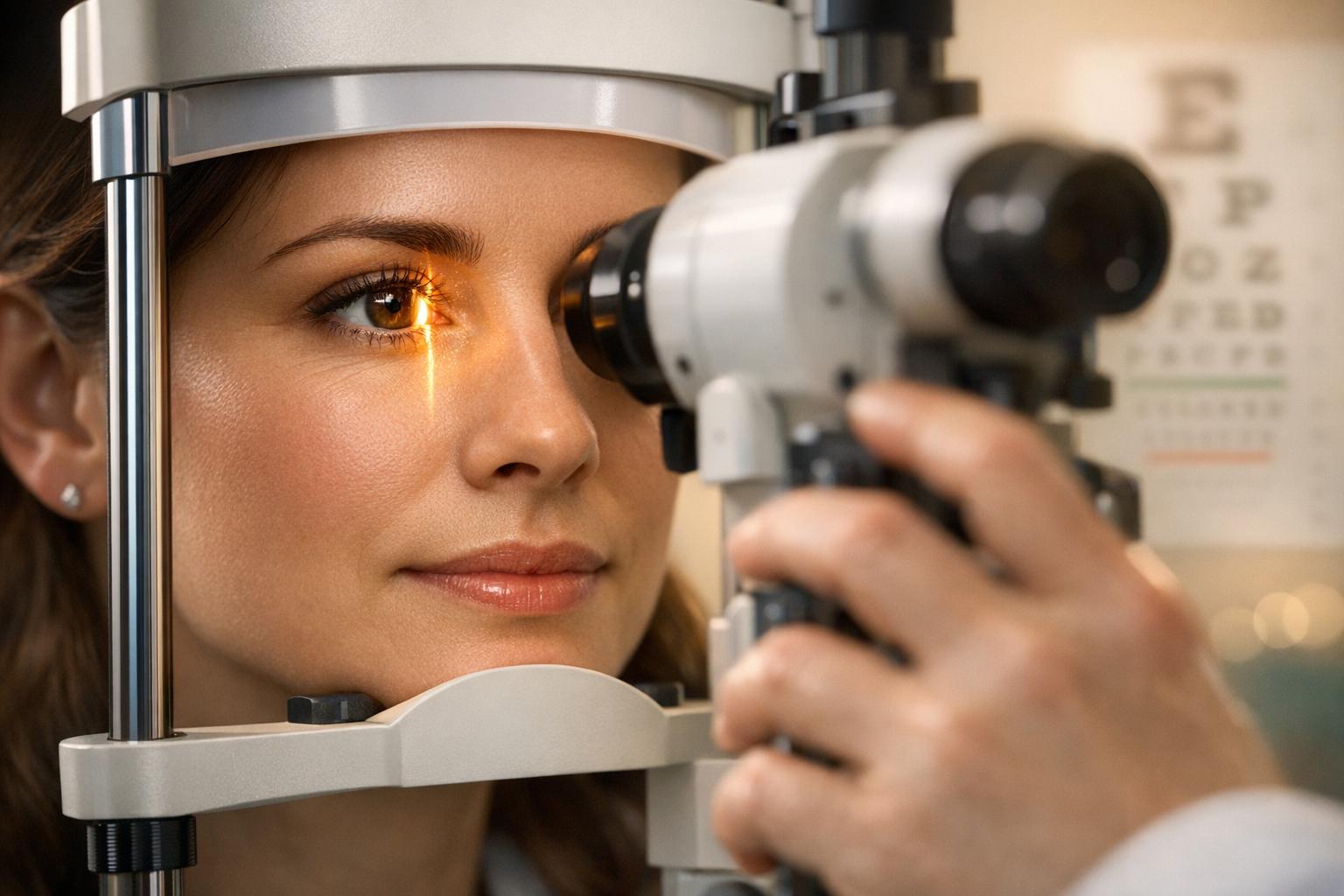
Eye exams don’t just focus on central vision – they also assess peripheral vision and overall eye function. A slit-lamp microscope provides a close-up view of your eye’s structures, such as the eyelids, cornea, iris, and lens. Meanwhile, a visual field test uses a perimeter to detect blind spots in your peripheral vision, which can signal glaucoma or neurological issues.
"An ophthalmoscope is an instrument that enables a doctor to examine the inside of a person’s eye… With it, a doctor can see the retina, the optic nerve, the retinal veins and arteries." – Leila M. Khazaeni, MD, Loma Linda University School of Medicine
Other specialized tools include Ishihara plates, which screen for color blindness, and the Amsler grid, used to detect distortions in central vision that may indicate macular degeneration.
At the Eye Center of Northern Colorado, these tools and techniques are part of a comprehensive approach to identifying vision problems early, allowing for timely and personalized care.
What Happens During a Routine Eye Exam
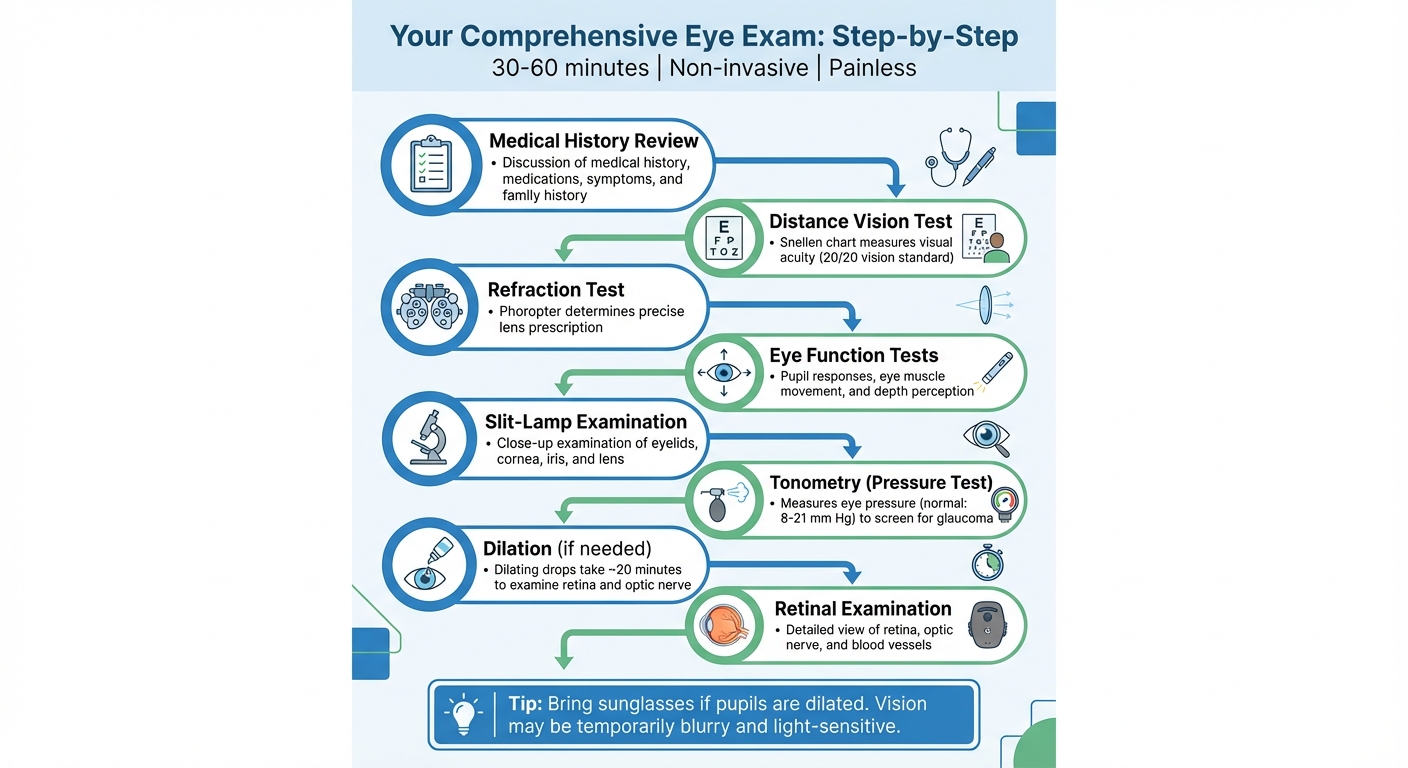
What Happens During a Comprehensive Eye Exam: Step-by-Step Process
The Exam Steps
A routine eye exam begins with a discussion about your medical history, current medications, symptoms, and family history. This helps identify any potential risk factors for vision problems.
The next step involves testing your distance vision using a Snellen chart, followed by a refraction test with a phoropter to determine your lens prescription. Additional tests check pupil responses, eye muscle movement, and depth perception to ensure everything is functioning as it should.
A slit-lamp exam is used to closely examine the front part of your eye, while tonometry measures your eye pressure. If needed, your doctor may use dilating drops to get a better look at your retina and optic nerve. These drops usually take about 20 minutes to work.
"The tests cause no pain or discomfort." – UF Health
Each of these steps is carefully designed to detect early signs of vision issues, providing a comprehensive evaluation of your eye health.
Duration and Comfort Level
A typical eye exam takes about 30–60 minutes, though more complex cases might take a little longer. All procedures are non-invasive and painless. At most, you might feel a quick puff of air or a slight sting from the dilating drops.
If your pupils are dilated, it’s smart to bring sunglasses for the ride home since your vision might be blurry and sensitive to light temporarily. You might also want to arrange for someone else to drive if you’re not comfortable driving afterward. The team at the Eye Center of Northern Colorado ensures you’re informed and comfortable throughout the entire process.
Conclusion
Routine eye exams play a crucial role in detecting serious eye conditions like glaucoma, macular degeneration, and diabetic retinopathy at an early stage – often before symptoms appear and irreversible damage occurs. For instance, early treatment can help prevent or delay diabetic retinopathy in 90% of individuals with diabetes. These exams don’t just protect your vision; they can also uncover early signs of broader health issues, such as diabetes, high blood pressure, and autoimmune disorders.
For those with diabetes, high blood pressure, or a family history of eye disease, annual exams are a must. Otherwise, follow these age-based recommendations: adults aged 40–54 should schedule exams every 2–4 years, those 55–64 every 1–3 years, and individuals 65 and older every 1–2 years.
Taking a proactive approach to eye care not only helps prevent vision loss but also supports overall health and well-being. Consider scheduling your next exam at the Eye Center of Northern Colorado. With multiple locations across Northern Colorado and Wyoming, it’s a convenient way to protect your vision and maintain your independence for years to come.
FAQs
How often should I get an eye exam?
It’s often suggested to schedule an eye exam every 1 to 2 years if you’re not experiencing symptoms or don’t have specific risk factors. However, factors like your age, general health, or existing eye conditions might mean you need to visit more often. These regular check-ups play a key role in catching and addressing vision problems early.
Do I need an eye exam if my vision seems fine?
Regular eye exams play a crucial role in protecting your eye health, even if your vision feels perfectly fine. These checkups can uncover early signs of eye conditions and even detect broader health issues before noticeable symptoms arise. Catching problems early often leads to more effective treatment, helping you safeguard your vision for the long haul.
Will my eyes be dilated during the exam?
Yes, your eyes will be dilated during the exam. The doctor will use eye drops to enlarge your pupils, making it easier to get a clear view of the back of your eye. This process helps in spotting early signs of eye conditions and addressing potential vision problems before they worsen.