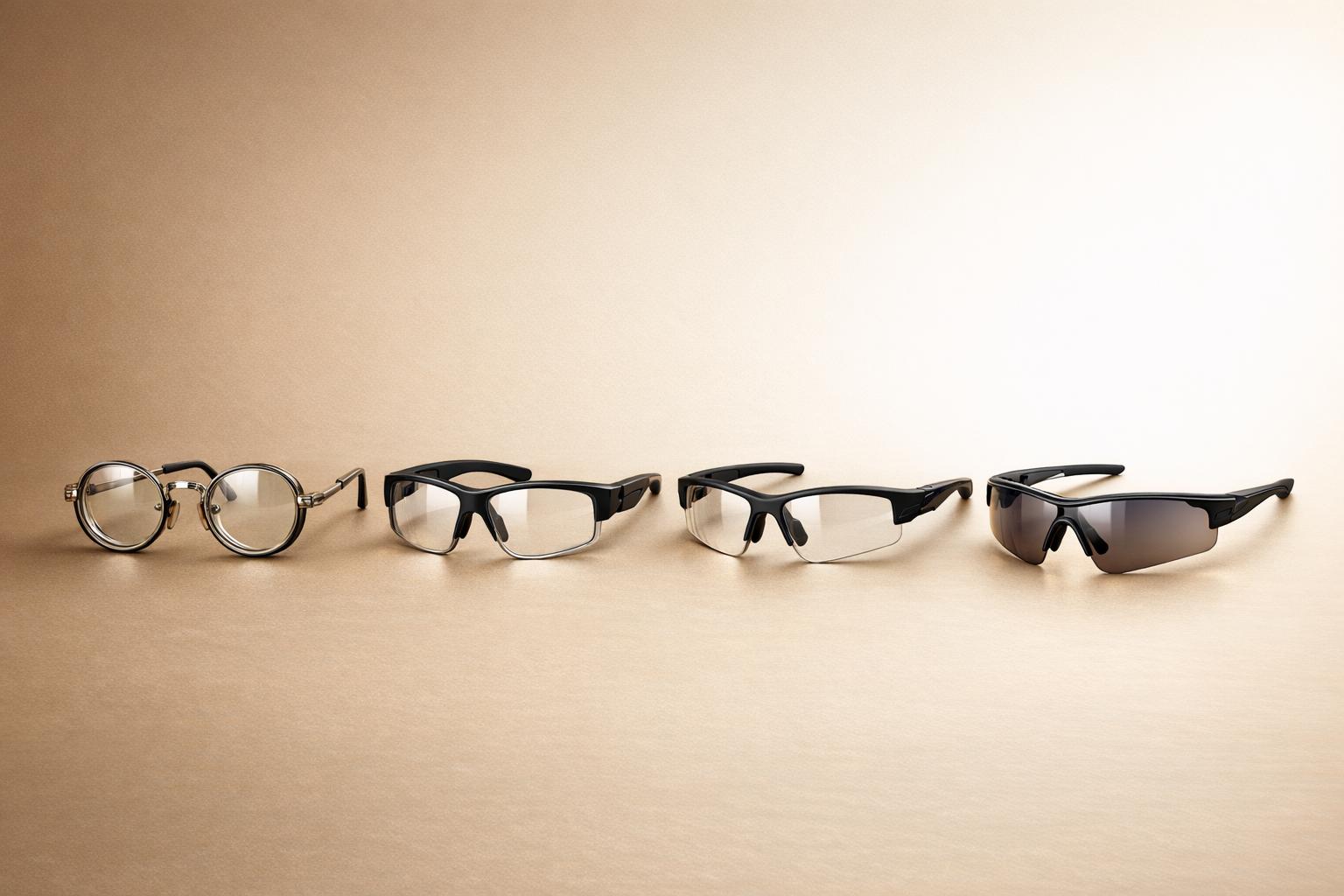
Sports glasses have transformed dramatically over the years, moving from heavy, fragile designs to lighter, safer, and more durable options. Early models used materials like leather, glass, and metal, which were impractical for sports due to their weight and tendency to shatter. By the mid-20th century, plastics like CR-39 and nylon introduced lighter, more flexible alternatives. The 1980s saw the rise of polycarbonate, a material offering superior impact resistance and UV protection, making it ideal for high-risk sports. Today, advanced polymers like TR90 and lens materials such as Trivex dominate, combining lightweight comfort with exceptional durability. Modern coatings, including anti-fog, polarized, and photochromic options, further enhance performance and safety.
Key Takeaways:
- Early Materials: Leather, rubber, and glass dominated but lacked durability and safety.
- 1950s-1970s: CR-39 plastic and nylon introduced lighter, more practical designs.
- 1980s-1990s: Polycarbonate lenses revolutionized safety and impact resistance.
- 2000s-Present: TR90 frames and Trivex lenses prioritize comfort, flexibility, and clarity.
These advancements have made sports eyewear safer and more functional, addressing the unique needs of athletes while reducing the risk of eye injuries by over 90%.
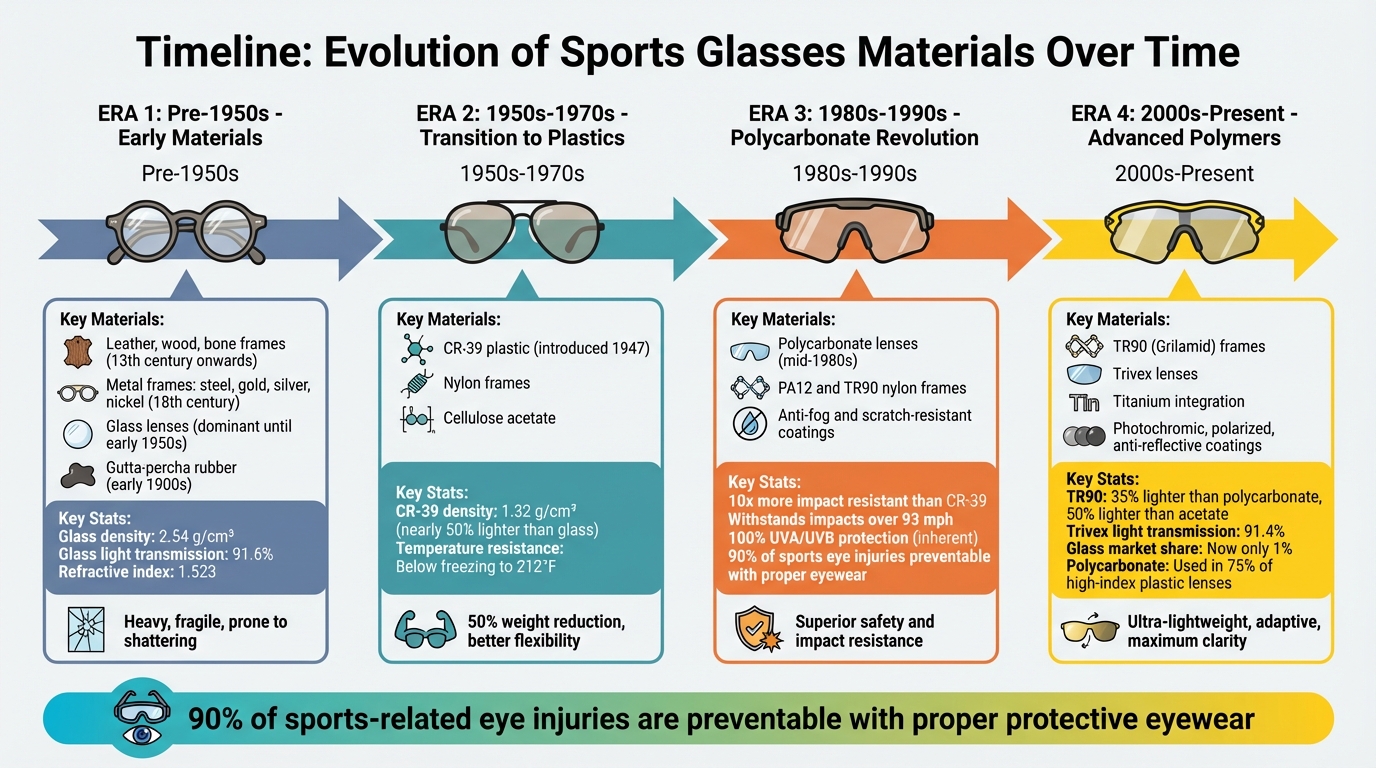
Evolution of Sports Glasses Materials from Pre-1950s to Present
Early Materials in Sports Glasses (Pre-1950s)
Leather, Rubber, and Metal Frames
Before the 1950s, sports glasses were crafted using natural materials that were readily available. Dating back to the 13th century, spectacles often featured frames made from leather, wood, bone, or horn. Leather was especially popular because it was lightweight and flexible, allowing it to mold to the wearer’s face. However, it wasn’t ideal for sports – it wore out quickly and lacked the durability needed for physical activity.
By the 18th century, metal frames gained popularity. Materials like steel, gold, silver, and nickel were used for their strength and longevity. Edward Scarlett, a London optician, even introduced "temple glasses" with metal arms, providing a more secure fit. Still, metal had its downsides: steel corroded when exposed to sweat, and nickel sometimes caused skin irritation. In the early 1900s, manufacturers also experimented with gutta-percha, a rubber-like material that offered a more affordable alternative for frames.
These early innovations in frame materials laid the groundwork for future developments in sports eyewear.
Glass Lenses for Optical Clarity
While frames evolved, lens technology progressed on a parallel track. Glass dominated the lens market until the early 1950s. It was prized for its optical precision and scratch resistance. Crown glass, the most commonly used type, had a refractive index of 1.523 and an Abbe number of 58.6, offering excellent clarity. It also allowed about 91.6% of light to pass through.
However, glass lenses came with significant drawbacks for athletes. Weighing in at a density of 2.54 g/cm³, they were nearly twice as heavy as the CR-39 plastic lenses that came later (1.32 g/cm³). This extra weight often caused discomfort during prolonged use. Even more concerning, glass was brittle and could shatter on impact, posing a serious safety risk. As Dr. John Musumeci, an optometrist, noted:
"While glass boasts high resistance, it tends to be heavier and more prone to breakage, posing a risk of serious eye injuries".
These early material choices, though imperfect, set the stage for ongoing advancements in sports eyewear design and safety.
sbb-itb-5ef6ec9
Transition to Plastics (1950s-1970s)
Adoption of Nylon and CR-39 Materials
The post-war era brought groundbreaking changes to sports eyewear. In 1947, the Armorlite Lens Company in California pioneered the use of CR-39 plastic for eyeglass lenses – a material originally engineered in 1940 for B-17 bomber fuel tanks. This innovation cut lens weight nearly in half compared to traditional glass.
Nylon also became a game-changer for frame construction. Its flexibility and resilience made it perfect for high-impact sports. According to Eyewearbeyond:
"Nylon frames feel better and last longer in real sports conditions".
Nylon frames could endure extreme temperatures, from below freezing to 212°F, without warping. They also resisted sweat, sunscreen, and skin oils, unlike earlier materials. Meanwhile, cellulose acetate provided a lighter, hypoallergenic alternative to the tortoiseshell and animal horn used previously, which often caused discomfort and left marks on wearers’ noses. This shift wasn’t just technical; it also reflected changing attitudes. Pair Eyewear highlighted this transformation:
"The 1950s brought eyewear out of the fashion dark ages. People were no longer ashamed of their glasses".
Popularization of Aviator Designs
These material advancements paved the way for new designs that combined style with practicality. The aviator style, initially crafted with metal frames, played a pivotal role in driving the adoption of plastics in sports eyewear. Its large lenses required lighter materials to remain practical during physical activity. By the 1950s, acetate frames had been refined to mimic the aviator look while offering reduced weight and a spectrum of vibrant colors.
During this period, sports eyewear transitioned from basic protection to essential performance gear. Iconic athletes like Ted Williams and Joe DiMaggio helped popularize sunglasses on the baseball field during the 1950s and 1960s. Their use of wraparound designs, which provided a wider field of vision, sparked increased demand. The first designer-branded eyewear collection debuted in 1953, thanks to a collaboration between American Optical Company and Claire McCardell, followed by a 1956 partnership with Elsa Schiaparelli. Reflecting on this shift, Robert Roope, Founder & Designer of Black Eyewear, remarked:
"Within 15 years [of 1953] an avalanche of designer eyewear would finally dispel the stigma of having to wear glasses".
Polycarbonate and Performance Era (1980s-1990s)
Shatter-Resistant Polycarbonate Lenses
The 1980s brought a major leap in eyewear technology with the introduction of polycarbonate lenses. Originally designed in the 1950s for astronaut helmet visors and aircraft windows, polycarbonate eventually found a home in the optical industry. This material raised the bar for safety in eyewear.
Polycarbonate lenses were a game-changer, offering 10 times more impact resistance than CR-39 plastic. They could withstand projectiles traveling over 93 mph, making them ideal for high-risk sports like baseball, squash, and cricket. Unlike glass or standard plastic, which could shatter on impact, polycarbonate’s thermoplastic structure allowed it to flex or dent instead. As Liz Martinez, ABO, NCLC, put it:
"Polycarbonate is more flexible; it will flex rather than break."
The benefits didn’t stop at safety. Polycarbonate lenses were also lightweight, which opened doors for more versatile designs. They naturally blocked 100% of UVA and UVB rays without needing extra coatings, and their higher refractive index allowed for thinner, sleeker lenses. This paved the way for wraparound designs that improved peripheral protection. Carol Doherty, LDO and opticianry instructor, reflected on the material’s significance:
"At that time [1980s] polycarbonate was our only choice for a thinner, lighter lens."
These innovations laid the groundwork for eyewear that could meet the rigorous demands of athletes and outdoor enthusiasts.
Sports-Specific Features
The pairing of polycarbonate lenses with advanced nylon frames, such as PA12 and TR90, further elevated sports eyewear. These frames offered exceptional flexibility and durability, withstanding extreme temperatures – from below freezing to 212°F – and resisting damage from sweat, sunscreen, and skin oils.
To enhance functionality, anti-fog and scratch-resistant coatings were added, improving visibility and longevity. The flexibility of nylon frames also enabled wraparound designs that hugged the face, offering better lateral protection and a secure fit. Dual-injection molding introduced soft rubber on temples and nose pads, ensuring a snug, non-slip grip during intense activity.
This era marked a shift in priorities. After a 1972 FDA ruling mandated impact resistance for all lenses, the arrival of polycarbonate in the mid-1980s provided a material that met both safety standards and athletes’ needs for lightweight, comfortable eyewear. With over 90% of sports-related eye injuries deemed preventable through proper protective eyewear, polycarbonate quickly became the go-to choice for those seeking performance and protection.
Advanced Polymers and Coatings (2000s-Present)
Thermo-Plastics and Titanium Integration
Building on earlier advancements in plastics and polycarbonate, the 2000s brought a new wave of materials that redefined eyewear design. One standout is TR90 (Grilamid), a Swiss-engineered polymer that combines impressive durability with a lightweight feel. TR90 is up to 35% lighter than polycarbonate and 50% lighter than acetate, making it incredibly comfortable for extended wear. Its "memory" feature allows it to flex under pressure and snap back into shape, significantly reducing the risk of breakage. Plus, it remains flexible across various climates, making it a reliable choice for all-weather use. As an expert from Eyewearbeyond put it:
"If you want frames that bend instead of snap – and you want customers to say ‘wow, this feels light’ – go with TR90."
Titanium has also risen to prominence in high-performance sports eyewear. Known for its exceptional strength-to-weight ratio, titanium is both corrosion-resistant and hypoallergenic. It’s often paired with other materials, such as TR90 frames or co-molded TPU grips on nose pads and temples, to enhance comfort and ensure a secure fit during rigorous activity. The hypoallergenic nature of both TR90 and titanium also makes them ideal for athletes with sensitive skin.
On the lens side, Trivex is a standout material. Originally developed for military use, this lens material offers 91.4% light transmission, providing excellent optical clarity. It’s lighter than polycarbonate while maintaining comparable impact resistance, making it a top choice for prescription sports eyewear. These advances in frame and lens materials have paved the way for even more sophisticated lens technologies.
Photochromic, Polarized, and Anti-Reflective Coatings
Modern lenses now feature adaptive coatings that complement these advanced frames. Photochromic lenses, for instance, automatically adjust to lighting conditions by darkening under UV light and clearing indoors. These lenses can darken in under a minute while still absorbing up to 20% of ambient light even in their clearest state. This makes them particularly useful for athletes like cyclists and trail runners who frequently encounter shifting light conditions.
Polarized coatings are another key innovation, designed to block glare from reflective surfaces like roads, water, and snow by filtering horizontally polarized light. High-quality polarized lenses often use a "sandwich" construction, where the polarizing film is securely embedded between layers of polycarbonate. Additional treatments – such as hydrophobic, oleophobic, anti-fog, and anti-reflective coatings – further enhance visual clarity, reduce reflections, and minimize eye strain.
Together, these material and lens innovations not only improve athletic performance but also set a high standard for modern sports eyewear. At the Eye Center of Northern Colorado, the focus remains on offering eyewear that combines advanced technology with top-tier quality, ensuring athletes get the best tools for their visual needs.
Glasses Materials Guide – All Frame Materials COMPARED
Material Comparison Table
Choosing the right materials for sports eyewear can make a big difference in performance and safety. Here’s a breakdown of the most common lens and frame materials, compared by weight, shatter-resistance, UV protection, and cost – key factors to consider when picking sports glasses.
| Material | Weight | Shatter-Resistance | UV Protection | Relative Cost |
|---|---|---|---|---|
| Glass | Heavy | Low (Shatters) | Partial (Needs Coating) | Moderate |
| CR-39 (Plastic) | Moderate | Moderate | Limited (Needs Dye) | Low |
| Polycarbonate | Light | Excellent | 100% Inherent | Low |
| Trivex | Ultra-Light | Excellent | 100% Inherent | High/Premium |
| Nylon | Light | High | Varies | Low |
| TR90 (Frame) | Very Light | Excellent (Flexible) | N/A | Low |
This table captures the evolution of materials, showcasing how advancements have improved sports eyewear by making it safer, lighter, and more durable.
Polycarbonate, used in nearly 75% of high-index plastic lenses, stands out for its exceptional impact resistance, far surpassing glass or standard plastic. On the other hand, glass lenses, once dominant in the 1960s, now account for just 1% of the ophthalmic lens market due to their weight and tendency to shatter. For those seeking lightweight durability with excellent optical clarity, Trivex is a premium choice, though it comes with a higher price tag.
When it comes to frames, TR90 is a standout option. Known for being extremely lightweight and flexible, it’s a favorite for high-impact sports. As one expert from Eyewearglobo explains:
"TR90 is probably the most popular material for sports sunglasses today… it’s super lightweight, flexible, and nearly unbreakable in everyday use."
This flexibility and durability make TR90 an ideal choice for athletes who demand gear that can handle the rigors of intense activity.
These advancements in material technology have transformed sports eyewear, moving from heavy and fragile designs to gear that’s built for performance and resilience. If you’re unsure which material is right for you, the Eye Center of Northern Colorado can help you find eyewear tailored to your sport, vision, and budget.
Conclusion
The shift from heavy glass and metal to advanced polymers represents a major step forward in protecting athletes while enhancing their performance. Today’s sports eyewear is crafted with precision-engineered materials that deliver full UV protection at a fraction of the weight of earlier designs. For instance, polycarbonate lenses can handle impacts at speeds exceeding 93 mph.
A staggering 90% of sports-related eye injuries can be avoided by wearing proper protective eyewear. Modern materials not only offer better clarity and impact resistance but also bring unique advantages. TR90 frames, with their shape memory, resist breaking, while Trivex lenses provide a 91.4% light transmission rate for exceptional visual clarity.
As Ritika Das, an optometry expert, aptly puts it:
"In the world of sports, visual performance and eye protection go hand in hand".
This focus on performance has shifted the priority from simply using available materials to selecting those that meet the specific demands of athletes. As a result, eyewear standards have been redefined. Looking ahead, smart technologies and bio-based polymers promise even more advancements, ensuring that safety and performance remain top priorities.
Whether you’re an occasional player or a serious competitor, choosing eyewear made with materials like polycarbonate or Trivex is critical for safeguarding your vision and boosting your game. These innovations reflect a commitment to pairing athletes with the best possible solutions. If you’re considering upgrading your sports eyewear, the Eye Center of Northern Colorado can help you find the perfect match for your sport, prescription, and budget.
FAQs
Which lens material is best for my sport?
The ideal lens material for sports eyewear hinges on your specific needs, such as impact resistance, weight, and visual clarity. Polycarbonate lenses are a popular choice because they’re lightweight, tough, and excellent at withstanding impacts. If you’re looking for even sharper clarity, Trivex lenses might be the way to go. They share many of polycarbonate’s benefits but tend to be a bit thicker. On the other hand, glass lenses, while offering superior optical clarity, are heavier and far less impact-resistant, making them a poor fit for most sports activities. Prioritizing impact-resistant lenses is key for both safety and optimal performance.
Do I need polycarbonate if I’m not in high-impact sports?
Polycarbonate lenses might not be a must-have if you’re not engaging in high-impact sports. However, their strong resistance to impact and long-lasting durability make them a reliable option for daily use, providing extra protection and a longer lifespan.
What coatings are worth adding?
Anti-reflective coatings can make a noticeable difference for most types of eyewear. By increasing light transmission to around 98%, they help reduce glare and improve clarity. These benefits can enhance your visual experience, making them a smart upgrade for your glasses.